
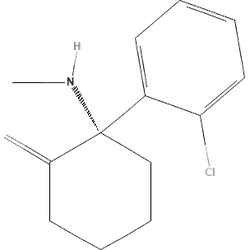
Esketamine Stats & Data
CNC1(CCCCC1=O)c1ccccc1ClYQEZLKZALYSWHR-ZDUSSCGKSA-NPharmacology
DrugBankDescription
Major depressive disorder (MDD) is a significant cause of disability worldwide and the most common illness preceding suicide , . On March 5, 2019, the nasal spray drug, _esketamine_, also known as _Spravato_ (by Janssen Pharmaceuticals), was approved by the FDA for treatment-resistant major depression. Esketamine is the s-enantiomer of Ketamine. Ketamine is a mixture of two enantiomers (mirror image molecules). This is the first time that the FDA has approved esketamine for any use. The FDA approved ketamine (Ketalar) in 1970 . Esketamine may prove to be a promising treatment for patients diagnosed with major depressive disorder who have not experienced an improvement in symptoms despite treatment with various medications and therapies. The intranasal route of administration for this drug allows for easy administration and a fast onset of action, which sets it apart from many other antidepressant agents that may take several weeks to take effect.
Mechanism of Action
Esketamine, the S-enantiomer of racemic ketamine, is a non-selective, non-competitive antagonist of the N-methyl-D-aspartate (NMDA) receptor, an ionotropic glutamate receptor. The exact mechanism by which esketamine acts as an antidepressant is unknown. The primary circulating metabolite of esketamine (_noresketamine_) shows activity at the same receptor with a weaker affinity .
Pharmacodynamics
**General effects** Esketamine is considered a central nervous system (CNS) depressant agent. It may cause sedation, dizziness, and lethargy, among other symptoms . This drug has dissociative and antidepressant properties . Acutely, esketamine may impair attention, judgment, thinking, reaction speed, and motor skills. Two placebo-controlled studies were performed to evaluate the effects of ketamine on the ability to drive. The effects of esketamine 84 mg were comparable to placebo at 6 hours and 18 hours post ingestion . **Effects on cardiac electrophysiology** The effect of esketamine (84 mg nasal spray and 0.8 mg/kg esketamine intravenously infused over 40 minutes) on the QTc interval was studied in a randomized, double-blind, placebo-, and positive-controlled (moxifloxacin 400 mg), 4-period, crossover study in 60 healthy volunteers. A marked increase in heart rate (higher than 10 bpm) was measured in subjects receiving intranasal and intravenous esketamine. Summative evidence from both nonclinical and clinical data suggests a lack of clinically relevant QTc prolongation at the normal therapeutic dose of esketamine . **Effects on blood pressure** Eskestamine causes increases in systolic and/or diastolic blood pressure at all therapeutic doses. Peak blood pressure elevation after esketamine administration occurs about 40 minutes after administration and lasts approximately 4 hours .
Metabolism
Esketamine is mainly metabolized to the _noresketamine_ metabolite by cytochrome P450 (CYP) enzymes, CYP2B6 and CYP3A4, and to a lesser extent, CYP2C9 and CYP2C19. Noresketamine is metabolized by cytochrome-dependent metabolic pathways followed by subsequent glucuronidation of metabolites .
Absorption
Due to the fact that this drug is administered via nasal spray, absorption is rapid. The mean absolute bioavailability is approximately 48% after esketamine nasal spray administration. The time to achieve peak esketamine plasma concentration is 20 to 40 minutes after the last nasal spray of esketamine. Inter-subject variability of esketamine ranges from 27% to 66% for Cmax (maximum concentration) and 18% to 45% for AUC (area under the curve). The intra-subject variability of esketamine is about 15% for Cmax and 10% for AUC .
Indication
This drug is indicated in conjunction with an oral antidepressant for the treatment of treatment-resistant depression (TRD) in adults . Note: Esketamine is not approved as an anesthetic agent. The safety and effectiveness of esketamine as an anesthetic agent have not been established to this date .
Half-life
The mean terminal half-life (t1/2) ranges from 7 to 12 hours .
Protein Binding
The protein binding of esketamine is about 43% to 45% .
Elimination
Less than 1% of a dose of nasal esketamine is measured as unchanged drug, excreted in the urine. Following intravenous (IV) or oral (PO) administration, esketamine-derived metabolites were mainly recovered in urine (≥ 78% of a radiolabeled dose), and a smaller percentage was measured in the feces (≤ 2% of a radiolabeled dose) .
Volume of Distribution
The average steady-state volume of distribution of esketamine administered by the intravenous route is 709 L .
Clearance
The average clearance of esketamine is approximately 89 L/hour following intravenous administration . Elimination of the major esketamine metabolite, _noresketamine_, from plasma is slower than esketamine. The decrease of noresketamine plasma concentrations occurs in a biphasic fashion, with a more rapid decline for the first 4 hours post-administration, and an average terminal t1/2 of approximately 8 hours .
Short-term exposure of cultures of GABAergic neurons to ketamine at high concentrations led to a significant loss of differentiated cells in one study, and non-cell death-inducing concentrations of ketamine (10 μg/ml) may still initiate long-term alterations of the dendritic arbor in differentiated neurons. More recent studies of ketamine-induced neurotoxicity have focused on primates in an attempt to use a more accurate model than rodents. One such study administered daily ketamine doses consistent with typical recreational doses (1 mg/kg IV) to adolescent cynomolgus monkeys for varying periods of time. Decreased locomotor activity and indicators of increased cell death in the prefrontal cortex were detected in monkeys given daily injections for six months, but not those given daily injections for one month.
Carcinogenicity
No indication of carcinogenicity to humans (not listed by IARC).
Overdose
Fatal ketamine overdoses are rare. Ketamine's toxicity drastically increases when it is mixed with other substances. Overdoses can cause respiratory depression, vomiting, positional asphyxia, heart problems, rhabdomyolysis causing kidney failure and rarely seizures.
Addiction & dependence
Ketamine has moderate to high abuse potential and produces psychological dependence with chronic use. When dependence has developed, cravings and withdrawal effects may occur if a person suddenly stops their usage. Tolerance to the main effects of ketamine develops with prolonged and repeated use.
Organ-specific toxicity
Short-term exposure of cultures of GABAergic neurons to ketamine at high concentrations led to a significant loss of differentiated cells in one study, and non-cell death-inducing concentrations of ketamine (10 μg/ml) may still initiate long-term alterations of the dendritic arbor in differentiated neurons. More recent studies of ketamine-induced neurotoxicity have focused on primates in an attempt to use a more accurate model than rodents. One such study administered daily ketamine doses consistent with typical recreational doses (1 mg/kg IV) to adolescent cynomolgus monkeys for varying periods of time.
Toxicity (DrugBank)
**Ketamine hydrochloride LD50**: 447 mg/kg, Rat (oral) **Neurotoxicity** In a one-dose neuronal toxicity study with esketamine intranasal administration to adult female rats, no finding of neuronal vacuolation in the brain occurred with doses up to the equivalent of the maximum recommended human dose of 84 mg/day. In a second single dose neurotoxicity study performed with intranasal esketamine administration in adult female rats, no observation of neuronal necrosis up to a dose equivalent to the maximum recommended human dose was made. Neuronal vacuolation was not evaluated in this study . The relevance of these findings in humans is unknown at this time . **A note on dependence and tolerance** Reports of physical dependence have been made following prolonged use of ketamine. Withdrawal signs and symptoms after abrupt discontinuation or significant dosage reduction of a drug is a common manifestation of drug dependence. There were no withdrawal symptoms observed up to 4 weeks in subjects after stopping esketamine treatment. Withdrawal symptoms have been observed after the discontinuation of frequently used (more than weekly) high doses of ketamine for a longer duration. These symptoms of withdrawal have a higher chance of occurring if esketamine was similarly abused . Symptoms of withdrawal reported to be associated with daily intake of high ketamine doses include craving, fatigue, poor appetite, and anxiety.
Effect Profile
CuratedStrong dissociative depth with strong motor impairment, mild mania and insight
Tolerance & Pharmacokinetics
drugs.wikiTolerance Decay
Rapid tolerance to subjective dissociation is commonly reported with repeated (daily or multi‑day) use and often partially decays over several days to weeks; estimates above are heuristic and based on community/HR summaries rather than controlled PK/PD studies.
Cross-Tolerances
Experience Report Analysis
ErowidDemographics
Gender Distribution
Too few reports for a chart: gender is known from 2 reports, and a split is drawn only from 20 reports or more. Counts are shown instead. Why 20?
- Male 2 of 2
Age Distribution
Reports Over Time
Harm Reduction
drugs.wikiEsketamine is the S‑enantiomer of ketamine and an FDA‑/EU‑approved nasal antidepressant; it causes dose‑dependent dissociation, cognitive/motor impairment, and transient hypertension. Intranasal bioavailability is ~48% with a 20–40 minute Tmax, so redosing too quickly can overshoot into heavier sedation or a hole-like state. It acutely elevates blood pressure and heart rate, peaking ~40 minutes and lasting up to ~4 hours, so people with uncontrolled hypertension, significant cardiovascular disease, recent stroke, intracranial/intraocular pressure problems, or serious head injury should avoid unsupervised use. Combining with alcohol, benzodiazepines, opioids, or GHB/GBL amplifies sedation and airway compromise; if someone becomes unresponsive or vomits, place them in the recovery position and seek help. Chronic/frequent use can damage the urinary tract (ketamine cystitis), presenting with urgency, frequency, dysuria, hematuria, and sometimes severe bladder contraction; stopping early improves outcomes and heavy users have required invasive treatments in severe cases. Snorting irritates mucosa—use finely crushed material, alternate nostrils, avoid sharing snorting tools, and rinse gently with saline after sessions to reduce epistaxis and infection risk. Use seated or lying down in a safe space with a trusted sober person if doses may impair mobility, and avoid driving or hazardous tasks until fully recovered. Unregulated markets see mis‑sold powders (e.g., ketamine sold as cocaine or 2C‑B), so drug checking is strongly advised to prevent unexpected dissociation and risky redosing. Outside clinical settings, IM is generally safer than IV if injecting at all, but both require sterile equipment, accurate measurement, and understanding of rapid onset. Nausea is common—avoid heavy meals for 1–2 hours beforehand and have antiemetic strategies planned if sensitive. Tolerance builds quickly; spacing sessions by at least several days and avoiding daily use markedly reduces compulsive redosing, bladder risk, and loss of effect.
References
Cited references
- DrugBank: Esketamine (DB11823) – PK, BP, driving, product info
- Hi‑Ground/DanceWize Ketamine HR page – dosing ranges, nasal care, combinations, contraindications
- DrugWise: Ketamine – urinary tract harm and K‑cramps overview
- Bluelight: Ketamine‑associated ulcerative cystitis (links PubMed; early case series)
- Drugs‑Forum Wiki: Ketamine – ROA/dose compendium (community HR)
- TripSit combination chart project (HR framing for combo risk)
- Saferparty drug checking warnings – ketamine mis‑sold as other drugs (2024–2025)