
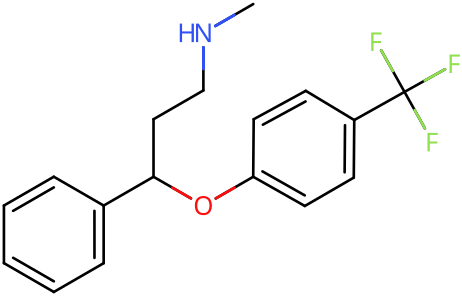
Fluoxetine Stats & Data
CNCCC(Oc1ccc(cc1)C(F)(F)F)c1ccccc1RTHCYVBBDHJXIQ-UHFFFAOYSA-NPharmacology
DrugBankDescription
Fluoxetine is a 2nd generation antidepressant categorized as a selective serotonin reuptake inhibitor (SSRI). It gained FDA approval in 1987 and although it was initially intended for the treatment of depression, today it is commonly prescribed to manage depression in addition to various other pathologies.
Mechanism of Action
The monoaminergic hypothesis of depression emerged in 1965 and linked depression with dysfunction of neurotransmitters such as noradrenaline and serotonin. Indeed, low levels of serotonin have been observed in the cerebrospinal fluid of patients diagnosed with depression. As a result of this hypothesis, drugs that modulate levels of serotonin such as fluoxetine were developed. Fluoxetine is a selective serotonin reuptake inhibitor (SSRI) and as the name suggests, it exerts it's therapeutic effect by inhibiting the presynaptic reuptake of the neurotransmitter serotonin. As a result, levels of 5-hydroxytryptamine (5-HT) are increased in various parts of the brain. Further, fluoxetine has high affinity for 5-HT transporters, weak affinity for noradrenaline transporters and no affinity for dopamine transporters indicating that it is 5-HT selective. Fluoxetine interacts to a degree with the 5-HT2C receptor and it has been suggested that through this mechanism, it is able to increase noradrenaline and dopamine levels in the prefrontal cortex.
Pharmacodynamics
Fluoxetine blocks the serotonin reuptake transporter in the presynaptic terminal, which ultimately results in sustained levels of 5-hydroxytryptamine (5-HT) in certain brain areas. However, fluoxetine binds with relatively poor affinity to 5-HT, dopaminergic, adrenergic, cholinergic, muscarinic, and histamine receptors which explains why it has a far more desirable adverse effect profile compared to earlier developed classes of antidepressants such as tricyclic antidepressants.
Metabolism
Fluoxetine is metabolized to norfluoxetine by CYP1A2, CYP2B6, CYP2C9, CYP2C19, CYP2D6, CYP3A4, and CYP3A5 upon ingestion. Although all of the mentioned enzymes contribute to N-demethylation of fluoxetine, CYP2D6, CYP2C9 and CYP3A4 appear to be the major contributing enzymes for phase I metabolism. In addition, there is evidence to suggest that CYP2C19 and CYP3A4 mediate O-dealkylation of fluoxetine and norfluoxetine to produce para-trifluoromethylphenol which is subsequently metabolized to hippuric acid. Both fluoxetine and norfluoxetine undergo glucuronidation to facilitate excretion. Notably, both the parent drug and active metabolite inhibit CYP2D6 isozymes, and as a result patients who are being treated with fluoxetine are susceptible to drug interactions.
Absorption
The oral bioavailability of fluoxetine is <90% as a result of hepatic first pass metabolism. In a bioequivalence study, the Cmax of fluoxetine 20 mg for the established reference formulation was 11.754 ng/mL while the Cmax for the proposed generic formulation was 11.786 ng/ml. Fluoxetine is very lipophilic and highly plasma protein bound, allowing the drug and it's active metabolite, norfluoxetine, to be distributed to the brain.
Indication
Fluoxetine is indicated for both acute and maintenance treatment of major depressive disorder, obsessive compulsive disorder, and bulimia nervosa; however, it is only indicated for acute treatment of panic disorder independent of whether agoraphobia is present. Fluoxetine may also be used in combination with olanzapine to treat depression related to Bipolar I Disorder, and treatment resistant depression.
Half-life
The half life of fluoxetine is significant with the elimination half-life of the parent drug averaging 1-3 days after acute administration, and 4-6 days after chronic administration. Further, the elimination half life of it's active metabolite, norfluoxetine, ranges from 4-16 days after both acute and chronic administration. The half-life of fluoxetine should be considered when switching patients from fluoxetine to another antidepressant since marked accumulation occurs after chronic use. Fluoxetine's long half-life may even be beneficial when discontinuing the drug since the risk of withdrawal is minimized.
Protein Binding
Approximately 94% of fluoxetine is plasma protein bound.
Elimination
Fluoxetine is primarily eliminated in the urine.
Volume of Distribution
The volume of distribution of fluoxetine and it's metabolite varies between 20 to 42 L/kg.
Clearance
The clearance value of fluoxetine in healthy patients is reported to be 9.6 ml/min/kg.
Measured Affinities
Guide to PHARMACOLOGYMeasured binding and functional data for fluoxetine, curated by the IUPHAR/BPS Guide to PHARMACOLOGY. Each row cites the paper it came from. Lower concentrations mean tighter binding — a value in the sub-nanomolar range indicates a very potent interaction.
| Target | Action | Measure | Value | Concentration | Species | Source |
|---|---|---|---|---|---|---|
| SERT SLC6A4 | Inhibition | pKi | 8.5 | 3.16 nM | Human | PMID 9537821 |
| 5-HT2C receptor Htr2c | Antagonist | pKi | 7.3 | 50.12 nM | Rat | PMID 11104741 |
| 5-HT2A receptor Htr2a | Antagonist | pKi | 6.5 | 316.23 nM | Rat | PMID 11104741 |
| Kv3.1 Kcnc1 | Gating inhibitor | pIC50 | 6.1 | 794.33 nM | Rat | PMID 11543764 |
| 5-HT6 receptor Htr6 | Antagonist | pKi | 5.8 | 1,585 nM | Rat | PMID 7680751 |
| 5-HT2B receptor HTR2B | Antagonist | pKi | 5.3 | 5,012 nM | Human | PMID 11104741 |
| Plasma membrane monoamine transporter SLC29A4 | Inhibition | pKi | 4.64 | 22,909 nM | Human | — |
| Kir3.2 Kcnj6 | Antagonist | pIC50 | — | — | Mouse | PMID 12684268 |
Reading this. pKi, pEC50 and pIC50 are negative log molar values, so a higher number means a tighter interaction; the concentration column converts them for you. Values from non-human species are laboratory measurements and do not translate directly to human effect. Receptor affinity is not a dose — it describes what a molecule binds, not how much of it is safe to take.
Receptor data from the IUPHAR/BPS Guide to PHARMACOLOGY (v2026.2), licensed CC BY-SA 4.0. Matched to this substance by InChIKey.
Fluoxetine is rarely lethal in monotherapy overdose. However, when taken with alcohol, it may cause ataxia and respiratory depression. Management of Overdose In the case of SSRI overdose, the goal is to provide supportive therapy. This support can be in the form of airway protection, serial ECGs to monitor for cardiotoxicity, administration of benzodiazepines for sedation, and GI decontamination with activated charcoal.
Carcinogenicity
No indication of carcinogenicity to humans (not listed by IARC).
Liver injury risk
Low concern (rare serious cases reported)
Toxicity (DrugBank)
In a report that included 234 fluoxetine overdose cases, it was concluded that symptoms resulting from fluoxetine overdose were generally minor and short in duration. The most common overdose adverse effects included drowsiness, tremor, tachycardia, nausea and vomiting, and providing the patient with aggressive supportive care was the recommended intervention. Despite this evidence, more severe adverse effects have been linked to fluoxetine ingestion although most of these reports involved co-ingestion with other substances or drugs as well as other factors. For example, there is a case report that details a patient who ingested 1400 mg of fluoxetine in a suicide attempt and as a result, experienced a generalized seizure three hours later. In a separate case, a 14 year old patient ingested 1.2 g of fluoxetine and subsequently experienced tonic/clonic seizures, symptoms consistent with serotonin syndrome, and rhabdomyolysis, although the patient did not experience sustained renal injury.
Health effects (PubChem excerpts)
Acute exposure to cholinesterase inhibitors can cause a cholinergic crisis characterized by severe nausea/vomiting, salivation, sweating, bradycardia, hypotension, collapse, and convulsions. Increasing muscle weakness is a possibility and may result in death if respiratory muscles are involved. Accumulation of ACh at motor nerves causes overstimulation of nicotinic expression at the neuromuscular junction. When this occurs symptoms such as muscle weakness, fatigue, muscle cramps, fasciculation, and paralysis can be seen. When there is an accumulation of ACh at autonomic ganglia this causes overstimulation of nicotinic expression in the sympathetic system. Symptoms associated with this are hypertension, and hypoglycemia. Overstimulation of nicotinic acetylcholine receptors in the central nervous system, due to accumulation of ACh, results in anxiety, headache, convulsions, ataxia, depression of respiration and circulation, tremor, general weakness, and potentially coma. When there is expression of muscarinic overstimulation due to excess acetylcholine at muscarinic acetylcholine receptors symptoms of visual disturbances, tightness in chest, wheezing due to bronchoconstriction, increased bronchial secretions, increased salivation, lacrimation, sweating, peristalsis, and urination can occur. Certain reproductive effects in fertility, growth, and development for males and females have been linked specifically to organophosphate pesticide exposure. Most of the research on reproductive effects has been conducted on farmers working with pesticides and insecticdes in rural areas. In females menstrual cycle disturbances, longer pregnancies, spontaneous abortions, stillbirths, and some developmental effects in offspring have been linked to organophosphate pesticide exposure. Prenatal exposure has been linked to impaired fetal growth and development. Neurotoxic effects have also been linked to poisoning with OP pesticides causing four neurotoxic effects in humans: cholinergic syndrome, intermediate syndrome, organophosphate-induced delayed polyneuropathy (OPIDP), and chronic organophosphate-induced neuropsychiatric disorder (COPIND). These syndromes result after acute and chronic exposure to OP pesticides.
Tolerance & Pharmacokinetics
drugs.wikiTolerance Decay
Experience Report Analysis
ErowidDemographics
Gender Distribution
Age Distribution
Reports Over Time
Effect Analysis
ErowidEffects aggregated from 11 experience reports (11 single-substance Erowid)
Effect Sentiment Distribution
Confidence Distribution
Each bar is the share of reports mentioning the effect; its whisker, and the band on the rows below, is the 95% interval: where the share could plausibly be with other reports of the same kind.
Too few reports for bars: these effects come from 11 single-substance Erowid reports, and a bar is drawn only from 20 reports or more. With fewer, a percentage cannot tell a common effect from a rare one. Counts are shown instead. Why 20?
Positive Effects 2
Adverse Effects 2
Show 1 neutral or unclassified mention
Also reported in combinations. In the 64 Fluoxetine reports where another drug was taken too, 13 (20.3%) mention hospital, emergency services or an overdose, 2 (3.1%) a seizure and 3 (4.7%) psychosis. In the 11 single-substance reports: 3, 0 and 0. These are not in the figures above: they cannot be put down to Fluoxetine alone, and a mention is not always something that happened to the writer.
Dosage Distribution
Dose distribution from experience reports, one dose per report (the first listed). Doses above Q3 + 3×IQR, far above what people typically take, are left out of the median and range and listed under each route: most are real heavy doses or overdoses, not mistakes.
Real-World Dose Distribution
ErowidFrom 106 of 117 recorded dose entries: those that state a weight (mg, g or µg), in routes with at least five of them. Values above Q3 + 3×IQR, far above what people typically take, are left out; they can include real heavy doses and overdoses, not only mistakes.
Oral (n=100)
Common Combinations
Most co-occurring substances, as a share of all 75 reports filed under Fluoxetine; whiskers are 95% intervals
Form / Preparation
Most common forms and preparations, as a share of the 11 reports that give one
Too few reports for bars: these forms come from 11 reports, and a bar is drawn only from 20 reports or more. With fewer, a percentage cannot tell a common effect from a rare one. Counts are shown instead. Why 20?
- Pill / Tablet 8 of 11
- Capsule 2 of 11
Body-Weight Dosing
Dose per kg of body weight, one dose per report (the first listed), from reports giving a weight of 30–250 kg. Doses above Q3 + 3×IQR, far above what people typically take, are left out of the median and range and listed under each route.
4 reports gave a dose above the typical range (1.471–5.039 mg/kg), so they are not in the figures above. Listing a dose here does not mean it is safe.
Show the reports
- 5.039 mg/kg · another drug taken too
- 4.412 mg/kg · another drug taken too
- 1.765 mg/kg · another drug taken too
- 1.471 mg/kg · another drug taken too
Redose Patterns
Redosing behavior across 69 reports