
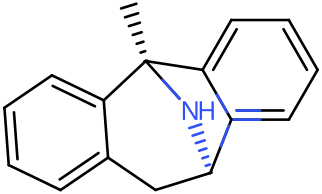
MK-801 Stats & Data
CC12C3=CC=CC=C3CC(N1)C4=CC=CC=C24.C(=CC(=O)O)C(=O)OQLTXKCWMEZIHBJ-PJGJYSAQSA-NReceptor Profile
Receptor Actions
Effect Profile
Curated + 1 ReportsMild dissociative depth with mild motor impairment and mania
Tolerance & Pharmacokinetics
drugs.wikiTolerance Decay
Dissociatives exhibit rapid, session-level tolerance with slow decay over 1–3 weeks. Frequent redosing extends duration non-linearly and can escalate confusion/insomnia. Cross-tolerance within NMDA antagonists is expected but not quantified in humans; values are heuristic based on user reports and class effects.
Cross-Tolerances
Experience Report Analysis
ErowidDemographics
Gender Distribution
Too few reports for a chart: gender is known from 3 reports, and a split is drawn only from 20 reports or more. Counts are shown instead. Why 20?
- Male 2 of 3
- Female 1 of 3
Age Distribution
Reports Over Time
Harm Reduction
drugs.wikiMicrogram-to-low-milligram potency demands accurate measurement: use true 0.1 mg resolution or, preferably, volumetric dosing (e.g., 10 mg in 100 mL = 0.1 mg/mL), pre-mark oral syringes, and lock away the remainder before dosing. Long, sometimes biphasic course (often a very late peak and a very long tail) plus severe amnesia can make redosing hazardous; several users report a strong compulsion to redose—remove access to stash and use a sober sitter. Duration commonly exceeds 24 h; plan no driving, machinery, or safety-critical tasks for at least 36–48 h after dosing. Insomnia and agitation are frequent during offset; avoid self-sedating with alcohol or benzos given additive respiratory/CNS depression—seek medical care if severe. Animal studies show rapid NMDA-antagonist vacuolization with high-dose MK-801; human relevance is uncertain but avoiding heavy doses/combos and spacing sessions remains prudent. Injection (IM) has unique risks (sterility, solvent, pH); multiple anecdotal abscess/necrosis cases—best avoided outside clinical settings. Because enantiomer and salt forms can differ in potency and time-course, do not assume one vendor’s dose applies to another. Use reagent/lab testing where available; misidentified dissociatives circulate. First exposure: ≤0.25 mg single dose, no redose, and allow ≥14 days between trials. Maintain hydration and electrolytes, keep ambient temperature comfortable, and ensure a secure, supervised environment with minimal navigation hazards.
References
Data Sources
Cited References
- Bluelight: MK-801 2.5 mg total (IM + rectal) trip report
- Clinical physiology and mechanism of dizocilpine (PMC)
- Erowid Experience: 3mg oral trip report
- Erowid Experience: IM dosing series
- Erowid Experience: The Most Beautiful Lobotomy I Ever Had
- Multiple-drug fatality case (MK-801 + benzodiazepines + alcohol)
- Wikipedia: Olney's lesions
- Plasma and brain half-life in rats (PubMed)
- TripSit: MK-801 Factsheet
- Bluelight: MK-801 (4 mg sublingual) trip report
Additional references
- PubChem – Dizocilpine compound summary (tool compound; identifiers)
- PubChem – Dizocilpine maleate (salt information)
- Bluelight – MK-801 or Dizocilpine (trip report; 2.5 mg; very long duration; late peak)
- Bluelight – Dizocilpine maleate questions (reports of IM abscess/necrosis)
- Drugs-Forum – MK-801 thread (dose caution; microgram–mg range)
- Reddit – Dizocilpine live trip report (late peak, long course, strong redosing compulsion)
- Reddit – MK-801 first trials (250 µg report; onset; racemate vs enantiomer discussion)
- Erowid PCP info page (historical notes listing MK-801 as non-anaesthetic dissociative; long duration)
- Bluelight – DXM brain damage thread (quotes animal data: MK-801 produces RS/PC vacuoles in rats)
- Drug Users Bible – The 10 Commandments of Safer Drug Use (volumetric dosing, scale accuracy)
- Toronto’s Drug Checking Service – About (access to GC-MS/LC-MS drug checking)