
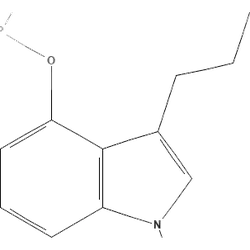
Psilocybin Stats & Data
QVDSEJDULKLHCG-UHFFFAOYSA-NPharmacology
DrugBankDescription
Cultivated mushroom allergenic extract is used in allergenic testing.
Measured Affinities
Guide to PHARMACOLOGYMeasured binding and functional data for psilocybin, curated by the IUPHAR/BPS Guide to PHARMACOLOGY. Each row cites the paper it came from. Lower concentrations mean tighter binding — a value in the sub-nanomolar range indicates a very potent interaction.
| Target | Action | Measure | Value | Concentration | Species | Source |
|---|---|---|---|---|---|---|
| 5-HT2C receptor HTR2C | Agonist | pEC50 | 7.13 | 74.13 nM | Human | PMID 16061378 |
Reading this. pKi, pEC50 and pIC50 are negative log molar values, so a higher number means a tighter interaction; the concentration column converts them for you. Values from non-human species are laboratory measurements and do not translate directly to human effect. Receptor affinity is not a dose — it describes what a molecule binds, not how much of it is safe to take.
Receptor data from the IUPHAR/BPS Guide to PHARMACOLOGY (v2026.2), licensed CC BY-SA 4.0. Matched to this substance by InChIKey.
study ranking various drugs (legal and illegal) based on statements by drug-harm experts. This study rated "mushroom" the least harmful drug overall and for users, and the only drug that didn't get any scores for harm on others.]] Numerous studies have found that psilocybin mushrooms are physiologically well-tolerated and has an extremely low toxicity relative to dose. There is no evidence for long-lasting effects on the brain or other organs and there are no documented deaths attributed to the direct effects of psilocybin mushrooms toxicity. However, it is worth noting that while they may not be capable of causing direct bodily toxicity or death, their use can still present serious hazards. For example, they are capable of strongly impairing the user's judgment and attention span, which may promote erratic or dangerous behaviors.
LD50
LD50: 280 mg/kg (Oral, Rat) (L1143)
Carcinogenicity
No indication of carcinogenicity to humans (not listed by IARC).
Addiction & dependence
Like other serotonergic psychedelics, psilocybin mushrooms have low abuse potential|low abuse and no physical dependence potential. There are no literature reports of successful attempts to train animals to self-administer a serotonergic psychedelic, which is predictive of abuse liability, indicating that it does not have the necessary pharmacology to either initiate or maintain dependence. Additionally, there is no human clinical evidence that psilocybin mushrooms causes addiction.
Psychosis & mental-disorder risk
Psilocybin mushrooms can exacerbate symptoms (e.g. delusions, mania, psychosis) of various mental disorders. Additionally, they can precipitate the early onset of schizophrenia in vulnerable individuals.
Effect Profile
Curated + 1,720 ReportsStrong visuals, auditory effects, and headspace with moderate body load
Community Effects
TripSitTolerance & Pharmacokinetics
drugs.wikiTolerance Decay
Cross-Tolerances
Experience Report Analysis
ErowidDemographics
Gender Distribution
Age Distribution
Reports Over Time
Effect Analysis
ErowidEffects aggregated from 1,720 experience reports (1,720 single-substance Erowid)
Effect Sentiment Distribution
Confidence Distribution
Each bar is the share of reports mentioning the effect; its whisker, and the band on the rows below, is the 95% interval: where the share could plausibly be with other reports of the same kind.
Positive Effects 13
Adverse Effects 14
Show 6 neutral or unclassified mentions
Also reported in combinations. In the 1,289 Psilocybin reports where another drug was taken too, 113 (8.8%) mention hospital, emergency services or an overdose, 33 (2.6%) a seizure and 66 (5.1%) psychosis. In the 1,720 single-substance reports: 9.1%, 2.3% and 4.7%. These are not in the figures above: they cannot be put down to Psilocybin alone, and a mention is not always something that happened to the writer.
Dosage Distribution
Dose distribution from experience reports, one dose per report (the first listed). Doses above Q3 + 3×IQR, far above what people typically take, are left out of the median and range and listed under each route: most are real heavy doses or overdoses, not mistakes.
Oral (mushrooms, other or unstated form, by weight)
Weight of mushrooms as reported, not of psilocybin.
20 reports gave a dose above the typical range (11.2–120 g), so they are not in the figures above. 2 of them mention hospital, emergency services or an overdose. Listing a dose here does not mean it is safe.
Show the reports
- 120 g
- 70 g
- 40 g · another drug taken too
- 28 g
- 20 g · mentions hospital, emergency services or an overdose
- 20 g
- 20 g
- 20 g · another drug taken too
- 20 g
- 19.3 g · another drug taken too
- 17.5 g · another drug taken too
- 17 g · mentions hospital, emergency services or an overdose
- 16 g · another drug taken too
- 15 g · another drug taken too
- 15 g · another drug taken too
- 15 g
- 13 g
- 13 g · another drug taken too
- 12.5 g
- 11.2 g
Oral (dried mushrooms, by weight)
Weight of mushrooms as reported, not of psilocybin.
14 reports gave a dose above the typical range (10.5–30 g), so they are not in the figures above. 5 of them mention hospital, emergency services or an overdose. Listing a dose here does not mean it is safe.
Show the reports
- 30 g · mentions hospital, emergency services or an overdose
- 17 g · another drug taken too · mentions hospital, emergency services or an overdose
- 15 g
- 15 g · another drug taken too
- 15 g
- 14.5 g
- 14 g
- 14 g
- 14 g · another drug taken too · mentions hospital, emergency services or an overdose
- 14 g · another drug taken too
- 12.5 g · mentions hospital, emergency services or an overdose
- 10.5 g · mentions hospital, emergency services or an overdose
- 10.5 g
- 10.5 g
Oral (fresh mushrooms, by weight)
Weight of mushrooms as reported, not of psilocybin.
2 reports gave a dose above the typical range (100–160 g), so they are not in the figures above. Listing a dose here does not mean it is safe.
Smoked (dried mushrooms, by weight)
Weight of mushrooms as reported, not of psilocybin.
Smoked (mushrooms, other or unstated form, by weight)
Weight of mushrooms as reported, not of psilocybin.
Oral (truffles (sclerotia), by weight)
Weight of mushrooms as reported, not of psilocybin.
Common Combinations
Most co-occurring substances, as a share of all 3,009 reports filed under Psilocybin; whiskers are 95% intervals
Form / Preparation
Most common forms and preparations, as a share of the 2,347 reports that give one; whiskers are 95% intervals
Redose Patterns
Redosing behavior across 2455 reports