
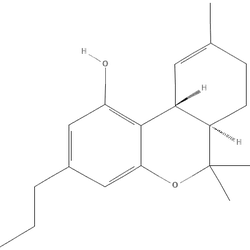
THCV Stats & Data
ZROLHBHDLIHEMS-HUUCEWRRSA-NPharmacology
DrugBankDescription
Tetrahydrocannabivarin (THCV) is a propyl analogue of tetrahydrocannabinol (Δ9-THC), one of the primary pharmacological components of Medical Cannabis. Δ9-THC is currently available in several synthetic forms, including Dronabinol, while purified or isolated THCV is not approved for any medical uses and is not available as any marketed products. As a major phytocannabinoid, however, THCV is accessible within Medical Cannabis along with other identified cannabinoids including Cannabidiol (CBD), cannabinol (CBN), cannabigerol (CBG), cannabichromene (CBC), cannabivarin (CBV), and Cannabidivarin (CBDV). THCV is one of four cannabinoids with identified potential as anticonvulsant agents, which also includes Δ9-tetrahydrocannabinolic acid, Cannabidiol (CBD), and Cannabidivarin (CBDV) . Although THCV possesses an almost identical structure to Δ9-THC (varying only by the length of its lipophilic alkyl chain), it has different molecular targets and pharmacological profile . Compared to THC which demonstrates its effects through weak partial agonist activity of both endocannabinoid receptors Cannabinoid-1 (CB1R) and Cannabinoid-2 (CB2R), THCV acts as a CB1 antagonist and a partial agonist of CB2 . Further evidence has also shown that THCV acts as an agonist of GPR55 and l-α-lysophosphatidylinositol (LPI) .
Pharmacodynamics
Compared to THC which demonstrates its effects through weak partial agonist activity at Cannabinoid-1 (CB1R) and Cannabinoid-2 (CB2R) receptors, THCV acts as a CB1 antagonist and a partial agonist of CB2 . Further evidence has also shown that THCV acts as an agonist of GPR55 and l-α-lysophosphatidylinositol (LPI) . Beyond the endocannabinoid system, THCV has also been reported to activate 5HT1A receptors to produce an antipsychotic effect that has therapeutic potential for ameliorating some of the negative, cognitive and positive symptoms of schizophrenia . Furthermore, THCV interacts with different transient receptor potential (TRP) channels including TRPV1, which may contribute to the analgesic, anti-inflammatory and anti-cancer effects of cannabinoids and Cannabis extracts .
Indication
THCV does not currently have any FDA, Health Canada, or EMA approved indications.
Measured Affinities
Guide to PHARMACOLOGYMeasured binding and functional data for tetrahydrocannabivarin, curated by the IUPHAR/BPS Guide to PHARMACOLOGY. Each row cites the paper it came from. Lower concentrations mean tighter binding — a value in the sub-nanomolar range indicates a very potent interaction.
| Target | Action | Measure | Value | Concentration | Species | Source |
|---|---|---|---|---|---|---|
| TRPV3 Trpv3 | Activation | pEC50 | 5.42 | 3,802 nM | Rat | PMID 21726418 |
| TRPV5 TRPV5 | Inhibition | pIC50 | 5.4 | 3,981 nM | Human | PMID 30170189 |
| TRPV6 TRPV6 | Inhibition | pIC50 | 5.05 | 8,913 nM | Human | PMID 30170189 |
Reading this. pKi, pEC50 and pIC50 are negative log molar values, so a higher number means a tighter interaction; the concentration column converts them for you. Values from non-human species are laboratory measurements and do not translate directly to human effect. Receptor affinity is not a dose — it describes what a molecule binds, not how much of it is safe to take.
Receptor data from the IUPHAR/BPS Guide to PHARMACOLOGY (v2026.2), licensed CC BY-SA 4.0. Matched to this substance by InChIKey.