
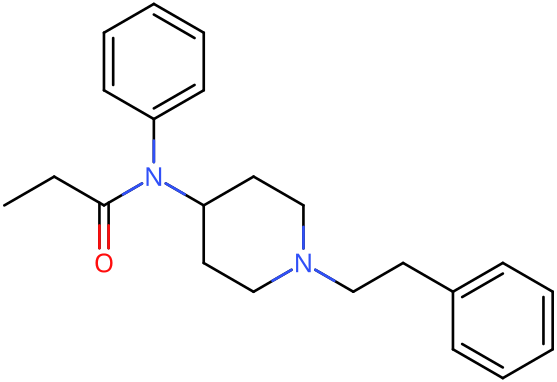
Fentanyl Stats & Data
CCC(=O)N(C1CCN(CC1)CCC2=CC=CC=C2)C3=CC=CC=C3PJMPHNIQZUBGLI-UHFFFAOYSA-NPharmacology
DrugBankDescription
Fentanyl, a potent opioid agonist, was developed in the 1950s to fill a need for strong and rapid analgesia. Because of these characteristics, fentanyl is commonly used to treat chronic cancer pain or in anesthesia. Fentanyl is related to other opioids like morphine and oxycodone. Fentanyl's high potency has also made it a common adulterant in illicit drugs, especially heroin. In 2017, 47600 overdose deaths in the United States involved some opioid (over 2/3 of all overdose deaths). Opioid overdoses kill an average of 11 Canadians daily. Fentanyl was FDA approved in 1968.
Mechanism of Action
Fentanyl binds to opioid receptors, especially the mu opioid receptor, which are coupled to G-proteins. Activation of opioid receptors causes GTP to be exchanged for GDP on the G-proteins which in turn down regulates adenylate cyclase, reducing concentrations of cAMP. Reduced cAMP decreases cAMP dependant influx of calcium ions into the cell. The exchange of GTP for GDP results in hyperpolarization of the cell and inhibition of nerve activity.
Pharmacodynamics
Fentanyl produces strong analgesia through its activation of opioid receptors. It has a duration of action of several hours and a wider therapeutic index as patients develop tolerance to opioids. Fentanyl is associated with a risk of addiction and abuse and should not be mixed with alcohol or benzodiazepines.
Metabolism
Fentanyl is metabolized to a number of inactive metabolites. Fentanyl is 99% N-dealkylated to norfentanyl by cytochrome P450. It can also be amide hydrolyzed to despropionylfentanyl, or alkyl hydroxylated to hydroxyfentanyl which is N-dealkylated to hydroxynorfentanyl.
Absorption
Fentanyl sublingual tablets are 54% bioavailable, transmucosal lozenges are 50% bioavailable, buccal tablets are 65% bioavailable, sublingual spray is 76% bioavailable, and nasal spray is 20% more bioavailable than transmucosal (or approximately 64% bioavailable). Fentanyl transmucosal lozenges reach a Cmax of 0.4±0.1ng/mL for a 200µg dose and 2.5±0.6ng/mL for a 1600µg dose with a Tmax of 20-40 minutes. The AUC was 172±96ng\*min/mL for a 200µg dose and 1508±1360ng\*min/mL for a 1600µg dose. Fentanyl sublingual spray reached a Cmax of 0.20±0.06ng/mL for a 100µg dose and 1.61±0.60ng/mL for an 800µg dose with a Tmax of 0.69-1.25 hours, decreasing as the dose increased. The AUC was 1.25±0.67ng\*h/mL for a 100µg dose and 10.38±3.70ng\*h/mL for a 800µg dose. Fentanyl transdermal systems reached a Cmax of 0.24±0.20ng/mL with a Tmax of 3.6±1.3h for a 25µg/h dose. The AUC was 0.42±0.35ng/mL\*h. Fentanyl nasal spray reaches a Cmax of 815±301pg/mL with a Tmax of less than 1 hour for a 200µg/100µL dose. The AUC was 3772pg\*h/mL.
Indication
Fentanyl intravenous or intramuscular injections are indicated for short term analgesia during induction, maintenance, and recovery from general or regional anesthesia. These injections are also used with a neuroleptic for premedication, induction, and as an adjunct to maintenance of anesthesia. Finally, fentanyl intravenous or intramuscular injections are used with oxygen for anesthesia in high risk patients. Fentanyl sublingual tablets, transmucosal lozenges, buccal tablets, sublingual sprays, transdermal systems, and nasal sprays are indicated for the management of breakthrough pain in opioid tolerant cancer patients who require around the clock pain management.
Half-life
The half life of fentanyl is 7 hours. The half life of fentanyl sublingual spray is 5-12 hours.
Protein Binding
Fentanyl is 80-85% bound to plasma proteins. In one study, a 0.1µg/L solution of fentanyl was 77.9±1.1% bound to human serum albumin and 12.0±5.4% bound to α-1 acid glycoprotein. A 0.1µg/L solution of norfentanyl, the primary metabolite of fentanyl, was 7.62±1.2% bound to human serum albumin and 7.24±1.9% bound to α-1 acid glycoprotein.
Elimination
Within 72 hours, 75% of a dose of fentanyl is excreted in the urine with <7% unchanged, and 9% is excreted in the feces with <1% unchanged.
Volume of Distribution
The intravenous volume of distribution is 4L/kg (3-8L/kg). The oral volume of distribution is 25.4L/kg. In hepatically impaired patients, the intravenous volume of distribution ranges from 0.8-8L/kg. Fentanyl crosses the blood brain barrier and the placenta.
Clearance
Total plasma clearance of fentanyl is 0.5L/hr/kg (0.3-0.7L/hr/kg) or 42L/hr. Following an intravenous dose, surgical patients displayed a clearance of 27-75L/h, hepatically impaired patients displayed a clearance of 3-80L/h, and renally impaired patients displayed a clearance of 30-78L/h.
Receptor Profile
Receptor Actions
Receptor Binding
Measured Affinities
Guide to PHARMACOLOGYMeasured binding and functional data for fentanyl, curated by the IUPHAR/BPS Guide to PHARMACOLOGY. Each row cites the paper it came from. Lower concentrations mean tighter binding — a value in the sub-nanomolar range indicates a very potent interaction.
| Target | Action | Measure | Value | Concentration | Species | Source |
|---|---|---|---|---|---|---|
| μ receptor Oprm1 | Full agonist | pKi | 9.4 | 0.398 nM | Rat | PMID 8114680 |
| μ receptor OPRM1 | Full agonist | pKi | 9.2 | 0.631 nM | Human | PMID 9686407 |
| κ receptor OPRK1 | Partial agonist | pKi | 7.1 | 79.43 nM | Human | PMID 9686407 |
| δ receptor OPRD1 | Full agonist | pKi | 6.8 | 158.49 nM | Human | PMID 9686407 |
Reading this. pKi, pEC50 and pIC50 are negative log molar values, so a higher number means a tighter interaction; the concentration column converts them for you. Values from non-human species are laboratory measurements and do not translate directly to human effect. Receptor affinity is not a dose — it describes what a molecule binds, not how much of it is safe to take.
Receptor data from the IUPHAR/BPS Guide to PHARMACOLOGY (v2026.2), licensed CC BY-SA 4.0. Matched to this substance by InChIKey.
History & Culture
1959–1968
Fentanyl was first synthesized in 1959 by Belgian scientist Paul Janssen at Janssen Pharmaceutica, his relatively newly established pharmaceutical company. The compound was developed through systematic screening of chemical analogues of pethidine (marketed as Demerol) for enhanced opioid activity, with the goal of creating a potent and rapid-acting analgesic suitable for clinical use. The drug entered medical practice in 1968 when fentanyl citrate was approved by the FDA and introduced as a general anesthetic under the brand name Sublimaze, manufactured by McNeil Laboratories. The clinical success of fentanyl subsequently prompted the development of numerous structurally related analogues, including sufentanil, alfentanil, remifentanil, and the exceptionally potent carfentanil, all of which were subsequently introduced into medical practice.
1990–2009
In the mid-1990s, Janssen Pharmaceutica developed the Duragesic patch, a transdermal delivery system consisting of an inert alcohol gel infused with measured fentanyl doses designed to provide continuous opioid administration over 48 to 72 hours. Following successful clinical trials, this formulation significantly expanded fentanyl's applications in palliative care. The first rapid-acting fentanyl formulation for outpatient use appeared in 1998 with the introduction of Actiq, a flavored lollipop containing fentanyl citrate mixed with inert fillers intended for managing chronic breakthrough pain. Additional delivery methods followed, including the Fentora buccal tablet. In 2009, the FDA approved Onsolis, a buccal soluble film formulation designed for cancer pain management in opioid-tolerant patients. By 2012, fentanyl had become the most widely used synthetic opioid in clinical practice worldwide. Global medical consumption reached approximately 1,600 kilograms in 2015, and by 2019, it ranked as the 278th most commonly prescribed medication in the United States with over one million annual prescriptions. The drug is included on the World Health Organization's List of Essential Medicines.
1970s–present
Illicit use of pharmaceutical fentanyl and clandestinely produced analogues first emerged in the mid-1970s, initially appearing within medical professional communities with access to the drug. The street name "China White" came to refer to various illicitly manufactured fentanyl analogues, particularly α-methylfentanyl and 3-methylfentanyl. A significant outbreak of overdose deaths occurred in 2006 when illegally manufactured fentanyl, frequently mixed with cocaine or heroin, appeared in the United States and Canada. This wave of fatalities was heavily concentrated in Dayton, Chicago, Detroit, and Philadelphia. Beginning around 2013, overdose deaths involving illicit fentanyl began accelerating dramatically. By 2018, fentanyl had surpassed heroin as the primary driver of drug overdose mortality in the United States. While deaths from prescription opioids remained relatively stable between 2011 and 2021, synthetic opioid deaths—predominantly involving fentanyl—increased from approximately 2,600 to over 70,600 annually. In 2021, fentanyl and its analogues were responsible for more than 71,238 overdose deaths in the United States alone. Estonia has been documented as experiencing the world's longest continuous fentanyl epidemic, a situation exacerbated by disruptions to heroin supply following the Taliban's ban on opium cultivation in Afghanistan. Due to fentanyl's extreme lethality, the substance has been voluntarily prohibited by major darknet markets.
2002–2018
Fentanyl and its analogues have been employed in several notable governmental operations. During the Moscow theater hostage crisis in October 2002, Russian Spetsnaz security forces deployed an aerosolized chemical agent to incapacitate hostage-takers. The agent was widely suspected to be a fentanyl derivative, possibly carfentanil or remifentanil, though Russian authorities never officially confirmed the specific compound used. In August 2018, Nebraska became the first American state to use fentanyl as part of a lethal injection protocol. Carey Dean Moore, at that time one of the longest-serving death row inmates in the United States, was executed at Nebraska State Penitentiary using an intravenous sequence of four drugs that included fentanyl citrate to induce unconsciousness and respiratory suppression.
Subjective Effects
Physical
- Pain relief: In comparison to other opiates, fentanyl can be described as a strong analgesic, providing relief even at non-recreational doses.
- Physical euphoria: This particular substance can be considered as less intense in its physical euphoria when compared with that of morphine or diacetylmorphine (heroin) due to the upper limit of how much can be converted into its active form through metabolism. The sensation itself can be described as strong feelings of intense physical comfort, warmth and physical blissful euphoria which spreads throughout the body.
- Itchiness: This compound presents very little itch response due to little to no amounts of histamine being release, unlike other opioids.
- Respiratory depression: In comparison to other opiates, fentanyl displays this effect at lower doses relative to euphoria then other opiates, and even at low doses results in the sensation that the breath is slowed down mildly to moderately, but does not cause noticeable impairment. At high doses and overdoses, opioid-induced respiratory depression can result in a shortness of breath, abnormal breathing patterns, semi-consciousness, or unconsciousness. Severe overdoses can result in a coma or death without immediate medical attention.
- Sedation: Fentanyl can be described as much more sedating then other opiates. Even at moderate dosages, this compound can result in overwhelming feelings of sedation and tiredness that is considerably more sedating than that of heroin and oxycodone.
- Constipation
- Cough suppression
- Difficulty urinating
- Pupil constriction
- Decreased libido
Cognitive
- Cognitive euphoria: This particular substance can be considered as less intense in its cognitive euphoria when compared with that of morphine or diacetylmorphine (heroin) due to the upper limit of how much can be converted into its active form through metabolism. It is still, however, capable of extreme intensity and overwhelming bliss at heavier dosages with a low tolerance. The sensation itself can be described as powerful and overwhelming feeling of emotional bliss, contentment, and happiness.
- Anxiety suppression
- Compulsive redosing
Forked from Subjective Effect Documentation work by Josie Kins, August 2016. Via dose.wiki (CC0).
Non-medical use of fentanyl by individuals without opiate tolerance can be very dangerous and has resulted in numerous deaths. It is potentially fatal at heavy dosages and even those with opiate tolerances are at high risk for overdoses. Once the fentanyl is in the user's system, it is extremely difficult to stop its course because of the nature of absorption. Because of the extremely high strength of pure fentanyl powder, it is very difficult to dilute appropriately, and often the resulting mixture may be far too strong and, therefore, very dangerous. It is also potentially lethal when mixed with depressants like alcohol or benzodiazepines.
LD50
LD50: 3.1 mg/kg (rat)LD50: 0.03 mg/kg (monkeys)
Carcinogenicity
No indication of carcinogenicity to humans (not listed by IARC).
Effect Profile
Curated + 99 ReportsStrong pain relief and sedation with moderate euphoria and itching/nausea
User Experiences
Tolerance & Pharmacokinetics
drugs.wikiNo tolerance chart. Our decay curves for opioids were estimates, and a curve can make tolerance look longer-lasting than it is, which is the dangerous direction.
Opioid tolerance drops fast when you stop, and even a few days off can be enough, so a dose that used to be normal can now stop your breathing. Overdose deaths rise sharply after prison, detox or leaving treatment, and tolerance also falls during a hospital stay. After any break, start with a much smaller amount, try a test dose first, don't use alone, and keep naloxone within reach. Alcohol, benzodiazepines, gabapentinoids and other sedatives make an opioid overdose much more likely.
Sources: FRANK: heroin · National Harm Reduction Coalition · WHO: opioid overdose · Merrall et al. 2010 · Binswanger et al. 2007 · Strang et al. 2003 · FDA 2019: gabapentinoids and breathing
Demographics
Gender Distribution
Age Distribution
Reports Over Time
Effect Analysis
Erowid + BluelightEffects aggregated from 99 experience reports (79 single-substance Erowid + 20 Bluelight)
Effect Sentiment Distribution
Confidence Distribution
Each bar is the share of reports mentioning the effect; its whisker, and the band on the rows below, is the 95% interval: where the share could plausibly be with other reports of the same kind.
Positive Effects 28
Adverse Effects 28
Show 8 more adverse effects
Show 13 neutral or unclassified mentions
Also reported in combinations. In the 29 Fentanyl reports where another drug was taken too, 12 (41.4%) mention hospital, emergency services or an overdose, 0 (0.0%) a seizure and 0 (0.0%) psychosis. In the 79 single-substance reports: 25.3%, 0.0% and 0.0%. These are not in the figures above: they cannot be put down to Fentanyl alone, and a mention is not always something that happened to the writer.
Dose-Response Correlation
How effect frequency changes across dose levels. Whiskers, and the numbers' hover text, give each figure's 95% interval.
View data table
| Effect | Threshold (n=21) |
|---|---|
| Nausea | 52.4% (95% interval 32 to 72 percent) |
| Euphoria | 42.9% (95% interval 24 to 64 percent) |
| Tactile Enhancement | 33.3% (95% interval 17 to 55 percent) |
| Stimulation | 28.6% (95% interval 14 to 50 percent) |
| Anxiety | 23.8% (95% interval 11 to 45 percent) |
| Hospital | 23.8% (95% interval 11 to 45 percent) |
| Body High | 23.8% (95% interval 11 to 45 percent) |
| Sedation | 23.8% (95% interval 11 to 45 percent) |
| Dissociation | 19.0% (95% interval 8 to 40 percent) |
| Pain Relief | 14.3% (95% interval 5 to 35 percent) |
| Headache | 14.3% (95% interval 5 to 35 percent) |
| Color Enhancement | 14.3% (95% interval 5 to 35 percent) |
| Auditory Effects | 9.5% (95% interval 3 to 29 percent) |
| Confusion | 9.5% (95% interval 3 to 29 percent) |
Dose–Effect Mapping
Experience ReportsHow reported effects shift across dose tiers, based on 79 single-substance experience reports. The shaded band on each bar is its 95% interval. An arrow (↑ ↓) marks a change between the lowest and highest tier that count an effect only when the gap is bigger than chance would explain; ~ means no clear change. How changes are called
Limited tier coverage — most reports fall within the Threshold range. Effects at other dose levels may not be represented.
| Effect | Threshold (n=21) | Change with dose |
|---|---|---|
| nausea | ||
| euphoria | ||
| tactile enhancement | ||
| stimulation | ||
| anxiety | ||
| hospital | ||
| body high | ||
| sedation | ||
| dissociation | ||
| pain relief | ||
| headache | ||
| color enhancement | ||
| auditory effects | ||
| confusion |
Dosage Distribution
Dose distribution from experience reports, one dose per report (the first listed). Doses above Q3 + 3×IQR, far above what people typically take, are left out of the median and range and listed under each route: most are real heavy doses or overdoses, not mistakes.
Real-World Dose Distribution
ErowidFrom 73 of 96 recorded dose entries: those that state a weight (mg, g or µg), in routes with at least five of them. Values above Q3 + 3×IQR, far above what people typically take, are left out; they can include real heavy doses and overdoses, not only mistakes.
Sublingual (n=16)
Intravenous (n=7)
Transdermal (n=34)
Oral (n=7)
Common Combinations
Most co-occurring substances, as a share of all 108 reports filed under Fentanyl; whiskers are 95% intervals
Form / Preparation
Most common forms and preparations, as a share of the 82 reports that give one; whiskers are 95% intervals
Body-Weight Dosing
Dose per kg of body weight, one dose per report (the first listed), from reports giving a weight of 30–250 kg. Doses above Q3 + 3×IQR, far above what people typically take, are left out of the median and range and listed under each route.
Transdermal
1 report gave a dose above the typical range (0.042 mg/kg), so it is not in the figures above. Listing a dose here does not mean it is safe.
2 doses more than 50 times the median may be a typing or unit error and are not in the figures either: check the report.
Sublingual
Unknown
Oral
Redose Patterns
Redosing behavior across 91 reports
Opioid Equivalence (MME)
NIH HEAL 2024 & CDC 2022Fentanyl ~77 µg buccal ≈ 10 mg Morphine oral (buccal factor 0.13)
Legal Status
| Country | Status | Notes |
|---|---|---|
| Australia | Schedule 8 | Classified as a Schedule 8 controlled drug, meaning it is available for legitimate medical use under strict prescription controls. Additionally designated as a border controlled substance under Criminal Code Act 9.1.314, with further restrictions imposed by individual states and territories. Unauthorized possession, production, or supply is prohibited. |
| Austria | Prescription only (SMG/AMG) | Legal for medical use under the Arzneimittelgesetz (AMG). Unauthorized sale or possession without a prescription is illegal under the Suchtmittelgesetz (SMG, Narcotic Substances Act). |
| Canada | Schedule I CDSA | Controlled under Schedule I of the Controlled Drugs and Substances Act. Medical use requires prescription. In some jurisdictions such as Ontario, patients prescribed fentanyl patches must return used patches to pharmacies before receiving prescription refills as a diversion prevention measure. |
| Germany | Anlage III BtMG | Listed in Anlage III of the Betäubungsmittelgesetz (Narcotics Act), indicating it is a marketable and prescription-capable narcotic. Can only be prescribed using a special narcotic prescription form (Betäubungsmittelrezept). |
| Italy | Tabella I | Listed in Tabella I of the official tables of narcotic and psychotropic substances maintained by the Ministry of Health. Possession, purchase, and sale without authorization are illegal. |
| Netherlands | List I (Opiumwet) | Classified as a List I substance under the Opium Act. Medical use permitted with prescription, but unauthorized possession, production, and distribution are criminal offenses. |
| Russia | Schedule II | Controlled as a Schedule II substance under Russian drug control legislation. Medical use permitted under strict controls; unauthorized possession and distribution are prohibited. |
| Switzerland | Verzeichnis A | Specifically named in Verzeichnis A (List A) of controlled substances. Medicinal use is permitted with appropriate authorization, but non-medical possession and supply are prohibited. |
| Turkey | Red prescription only | Designated as a 'red prescription' substance, the most restricted prescription category in Turkey. Illegal to sell or possess without a valid prescription from an authorized physician. |
| United Kingdom | Class A | Controlled under the Misuse of Drugs Act 1971. Medical use permitted with appropriate prescription, but unauthorized possession, production, or supply carries severe criminal penalties. |
| United States | Schedule II | Controlled under the Controlled Substances Act as a Schedule II opiate. FDA approved for medical use since 1968. Illegal to sell without a DEA license and illegal to possess without a valid prescription. Certain formulations such as Abstral require distributors to implement FDA-approved risk evaluation and mitigation strategy (REMS) programs. |
Harm Reduction
drugs.wikiFentanyl is extremely potent (about 50-100x morphine). Overdose risk is high, especially with illicit or unknown dosages. Illicit fentanyl is a major driver of opioid overdose deaths. Naloxone can reverse fentanyl overdose but may require higher/multiple doses. Use only as prescribed and avoid mixing with other CNS depressants.