
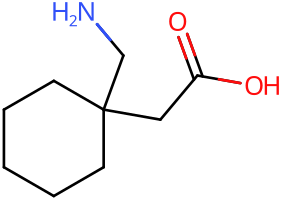
Gabapentin Stats & Data
NCC1(CCCCC1)CC(=O)[O-].[H+]UGJMXCAKCUNAIE-UHFFFAOYSA-NPharmacology
DrugBankDescription
Gabapentin is a structural analogue of the inhibitory neurotransmitter gamma-aminobutyric acid (GABA) that was first approved for use in the United States in 1993. It was originally developed as a novel anti-epileptic for the treatment of certain types of seizures - today it is also widely used to treat neuropathic pain. Gabapentin has some stark advantages as compared with other anti-epileptics, such as a relatively benign adverse effect profile, wide therapeutic index, and lack of appreciable metabolism making it unlikely to participate in pharmacokinetic drug interactions.. It is structurally and functionally related to another GABA derivative, pregabalin.
Mechanism of Action
The precise mechanism through which gabapentin exerts its therapeutic effects is unclear. The primary mode of action appears to be at the auxillary α2δ-1 subunit of voltage-gated calcium channels (though a low affinity for the α2δ-2 subunit has also been reported). The major function of these subunits is to facilitate the movement of pore-forming α1 subunits of calcium channels from the endoplasmic reticulum to the cell membrane of pre-synaptic neurons. There is evidence that chronic pain states can cause an increase in the expression of α2δ subunits and that these changes correlate with hyperalgesia. Gabapentin appears to inhibit the action of α2δ-1 subunits, thus decreasing the density of pre-synaptic voltage-gated calcium channels and subsequent release of excitatory neurotransmitters. It is likely that this inhibition is also responsible for the anti-epileptic action of gabapentin. There is some evidence that gabapentin also acts on adenosine receptors and voltage-gated potassium channels, though the clinical relevance of its action at these sites is unclear.
Pharmacodynamics
Gabapentin is an anti-convulsant medication that inhibits the release of excitatory neurotransmitters, allowing for its use against pathologic neurotransmission such as that seen in neuropathic pain and seizure disorders. It has a wide therapeutic index, with doses in excess of 8000 mg/kg failing to cause a fatal reaction in rats. Gabapentin is ineffective in absence seizures and should be used in caution in patients with mixed seizure disorders involving absence seizures. Gabapentin has been associated with drug reaction with eosinophilia and systemic symptoms (DRESS), otherwise known as multi-organ hypersensitivity. This reaction can prove fatal and early symptoms such as fever, lymphadenopathy, and rash should be promptly investigated.
Metabolism
Gabapentin is not appreciably metabolized in humans - in humans, metabolites account for less than 1% of an administered dose, with the remainder being excreted as unchanged parent drug in the urine.
Absorption
Absorption of gabapentin is thought to occur solely via facilitated transport by the LAT1 transporter within the intestines. As this process is saturable, the oral bioavailability of gabapentin is inversely proportional to the administered dose - the oral bioavailability of a 900mg/day regimen is approximately 60%, whereas a 4800mg/day regimen results in only 27% bioavailability. The Tmax of gabapentin has been estimated to be 2-3 hours. Food has no appreciable effect on gabapentin absorption.
Indication
In the United States, gabapentin is officially indicated for the treatment of postherpetic neuralgia in adults and for the adjunctive treatment of partial-onset seizures, with or without secondary generalization, in patients 3 years of age and older. In Europe, gabapentin is indicated for adjunctive therapy in the treatment of partial-onset seizures, with or without secondary generalization, in patients 6 years of age and older and as monotherapy in patients 12 years of age and older. It is also used in adults for the treatment of various types of peripheral neuropathic pain, such as painful diabetic neuropathy.
Half-life
The elimination t1/2 of gabapentin in patients with normal renal function is 5-7 hours. In patients with reduced renal function, the elimination t1/2 may be prolonged - in patients with a creatinine clearance of <30 mL/min, the reported half-life of gabapentin was approximately 52 hours.
Protein Binding
Less than 3% of an orally administered dose of gabapentin is bound to plasma proteins.
Elimination
Gabapentin is eliminated solely in the urine as unchanged drug. Cimetidine, an inhibitor of renal tubular secretion, reduces clearance by approximately 12%, suggesting that some degree of tubular secretion is involved in the renal elimination of gabapentin.
Volume of Distribution
The apparent volume of distribution of gabapentin after IV administration is 58±6 L. The drug is found in the CSF in concentrations approximately 9-20% of the corresponding plasma concentrations and is secreted into breast milk in concentrations similar to that seen in plasma.
Clearance
Both the plasma clearance and renal clearance of gabapentin are directly proportional to the patient's creatinine clearance due to its primarily renal elimination.
Receptor Profile
Receptor Actions
Receptor Binding
Measured Affinities
Guide to PHARMACOLOGYMeasured binding and functional data for gabapentin, curated by the IUPHAR/BPS Guide to PHARMACOLOGY. Each row cites the paper it came from. Lower concentrations mean tighter binding — a value in the sub-nanomolar range indicates a very potent interaction.
| Target | Action | Measure | Value | Concentration | Species | Source |
|---|---|---|---|---|---|---|
| Kv7.5 KCNQ5 | Activation | pEC50 | 8.72 | 1.91 nM | Human | PMID 30021858 |
| Kv7.3 KCNQ3 | Activation | pEC50 | 8.28 | 5.25 nM | Human | PMID 30021858 |
Reading this. pKi, pEC50 and pIC50 are negative log molar values, so a higher number means a tighter interaction; the concentration column converts them for you. Values from non-human species are laboratory measurements and do not translate directly to human effect. Receptor affinity is not a dose — it describes what a molecule binds, not how much of it is safe to take.
Receptor data from the IUPHAR/BPS Guide to PHARMACOLOGY (v2026.2), licensed CC BY-SA 4.0. Matched to this substance by InChIKey.
History & Culture
1974–1987
Gabapentin was conceived and synthesized at Goedecke AG, a Parke-Davis subsidiary located in Freiburg, Germany. The compound was designed as a structural analog of gamma-aminobutyric acid (GABA) with enhanced capacity to penetrate the blood-brain barrier. Initial synthesis occurred between 1974 and 1975, with Satzinger and Hartenstein publishing the first description of the compound in 1975. Preliminary clinical investigations explored potential applications for spasticity and migraine prophylaxis, though neither study enrolled sufficient participants to yield statistically meaningful conclusions. The compound's anticonvulsant potential became apparent in 1987 when a clinical trial demonstrated positive outcomes using gabapentin as adjunctive therapy in patients who continued experiencing seizures despite existing medication regimens.
1993–2011
Gabapentin received its initial regulatory approval in May 1993 when the United Kingdom authorized its use under the brand name Neurontin for treatment-resistant epilepsy. The United States Food and Drug Administration followed with approval in December 1993 for use as an adjunctive medication in adults with partial seizures, with the pediatric indication granted in 2000. Subsequent approvals expanded the drug's therapeutic applications. In 2002, United States regulators authorized gabapentin for postherpetic neuralgia. Generic formulations became available in the United States in 2004, while an extended-release version marketed as Gralise received approval in January 2011. By 2023, gabapentin had become the ninth most frequently prescribed medication in the United States, with over 45 million prescriptions dispensed annually. It serves as the prototype for a class of structurally and mechanistically related compounds known as gabapentinoids.
1990s–2004
During the 1990s, Parke-Davis engaged in extensive off-label promotion of gabapentin for unapproved medical indications using techniques that violated FDA marketing regulations. The ensuing Franklin v. Parke-Davis litigation resulted in Pfizer acknowledging these violations following its acquisition of the original patent holder. In 2004, Warner-Lambert (by then acquired by Pfizer) entered a guilty plea and agreed to pay $430 million in combined civil and criminal penalties. This settlement represented one of the largest pharmaceutical fraud resolutions in United States history at that time and established the first successful prosecution of off-label drug marketing under the False Claims Act. A separate controversy involved a treatment protocol marketed as PROMETA, which combined gabapentin with flumazenil, hydroxyzine, and supportive therapy as a purported intervention for methamphetamine addiction. Despite promotional claims suggesting efficacy for stimulant and alcohol dependence, the treatment combination was subsequently demonstrated to be ineffective.
Gabapentin's anxiolytic and mild euphoric properties have contributed to its emergence as a substance of recreational misuse. When consumed in quantities exceeding therapeutic doses, the drug can produce euphoria, enhanced sociability, and a sense of calm, leading some to characterize it as resembling a mild benzodiazepine. Street terminology includes "gabbies," and reports from 2017 documented increasing patterns of non-medical use and diversion. The relationship between prescription opioid restrictions and gabapentin misuse became apparent following regulatory changes in Kentucky, where implementation of stricter opioid prescribing requirements in 2012 coincided with subsequent increases in gabapentin-related incidents between 2012 and 2015, encompassing both single-substance misuse and polysubstance use patterns.
Subjective Effects
Physical
- Sedation: In terms of energy level alterations, gabapentin is mildly sedating and can potentially result in a lethargic state.
- Muscle relaxation
- Dizziness
- Seizure suppression
Cognitive
- Anxiety suppression
- Thought deceleration
- Cognitive euphoria
- Emotion suppression
Forked from Subjective Effect Documentation by Josie Kins, September 2015. Via dose.wiki (CC0).
GABApentin has a low toxicity relative to dose. The most common side effects of gabapentin in adult patients include dizziness, fatigue, drowsiness, weight gain, and peripheral edema (swelling of extremities). Gabapentin may also produce sexual dysfunction in some patients whose symptoms of which may include loss of libido, inability to reach orgasm, and erectile dysfunction. Gabapentin should be used carefully in patients with renal impairment due to possible accumulation and toxicity. It is strongly recommended that one use harm reduction practices when using this drug.
LD50
LD50: >8000 mg/kg (oral,rat) [MSDS]LD50: 8053 mg/kg (oral, mouse) [MSDS]
Carcinogenicity
No indication of carcinogenicity to humans (not listed by IARC).
Liver injury risk
Low concern (rare serious cases reported)
Addiction & dependence
Gabapentin is not considered psychologically addictive. However, it is possible to develop a physical dependence on the drug. In fact, people can experience withdrawal symptoms for up to 45 days after they stop taking gabapentin.
Tolerance & Pharmacokinetics
drugs.wikiNo tolerance chart. Our decay curves for these drugs were estimates, and a curve can make tolerance look longer-lasting than it is, which is the dangerous direction.
How fast tolerance to these drugs fades after a break has not been measured well enough to draw, so don't count on a dose you used to take still being safe: after time off, start with a much smaller amount and don't use alone. Mixing sedatives with each other, with alcohol or with opioids sharply raises the risk of a fatal overdose. If you've been using regularly, don't stop suddenly: withdrawal from benzodiazepines, alcohol or GHB/GBL can cause seizures or delirium, so get medical help to cut down gradually.
Sources: FRANK: benzodiazepines · Alcohol and Drug Foundation: GHB · FDA 2020: benzodiazepine boxed warning · FDA 2019: gabapentinoids and breathing · NHS: alcohol use disorder
Cross-Tolerances
Demographics
Gender Distribution
Age Distribution
Reports Over Time
Effect Analysis
Erowid + BluelightEffects aggregated from 142 experience reports (111 single-substance Erowid + 31 Bluelight)
Effect Sentiment Distribution
Confidence Distribution
Each bar is the share of reports mentioning the effect; its whisker, and the band on the rows below, is the 95% interval: where the share could plausibly be with other reports of the same kind.
Positive Effects 53
Adverse Effects 21
Show 1 more adverse effect
Show 19 neutral or unclassified mentions
Also reported in combinations. In the 67 Gabapentin reports where another drug was taken too, 8 (11.9%) mention hospital, emergency services or an overdose, 3 (4.5%) a seizure and 3 (4.5%) psychosis. In the 111 single-substance reports: 9.9%, 5.4% and 0.9%. These are not in the figures above: they cannot be put down to Gabapentin alone, and a mention is not always something that happened to the writer.
Dose-Response Correlation
How effect frequency changes across dose levels. Whiskers, and the numbers' hover text, give each figure's 95% interval.
Not drawn, too few reports (a dose tier needs 20): Oral Heavy (n=15). Why 20?
View data table
| Effect | Strong (n=25) |
|---|---|
| Euphoria | 56.0% (95% interval 37 to 73 percent) |
| Sedation | 28.0% (95% interval 14 to 48 percent) |
| Stimulation | 24.0% (95% interval 12 to 43 percent) |
| Empathy | 20.0% (95% interval 9 to 39 percent) |
| Music Enhancement | 16.0% (95% interval 6 to 35 percent) |
| Color Enhancement | 16.0% (95% interval 6 to 35 percent) |
| Headache | 12.0% (95% interval 4 to 30 percent) |
| Dissociation | 12.0% (95% interval 4 to 30 percent) |
| Motor Impairment | 12.0% (95% interval 4 to 30 percent) |
| Visual Distortions | 8.0% (95% interval 2 to 25 percent) |
| Hospital | 8.0% (95% interval 2 to 25 percent) |
| Introspection | 8.0% (95% interval 2 to 25 percent) |
| Nausea | 8.0% (95% interval 2 to 25 percent) |
| Focus Enhancement | 8.0% (95% interval 2 to 25 percent) |
Dose–Effect Mapping
Experience ReportsHow reported effects shift across dose tiers, based on 111 single-substance experience reports. The shaded band on each bar is its 95% interval. An arrow (↑ ↓) marks a change between the lowest and highest tier that count an effect only when the gap is bigger than chance would explain; ~ means no clear change. How changes are called
Not drawn, too few reports (a dose tier needs 20): Oral Heavy (n=15). Why 20?
Limited tier coverage — most reports fall within the Strong range. Effects at other dose levels may not be represented.
| Effect | Strong (n=25) | Change with dose |
|---|---|---|
| euphoria | ||
| sedation | ||
| stimulation | ||
| empathy | ||
| music enhancement | ||
| color enhancement | ||
| headache | ||
| dissociation | ||
| motor impairment | ||
| visual distortions | ||
| hospital | ||
| introspection | ||
| nausea | ||
| focus enhancement |
Dosage Distribution
Dose distribution from experience reports, one dose per report (the first listed). Doses above Q3 + 3×IQR, far above what people typically take, are left out of the median and range and listed under each route: most are real heavy doses or overdoses, not mistakes.
Real-World Dose Distribution
ErowidFrom 312 of 320 recorded dose entries: those that state a weight (mg, g or µg), in routes with at least five of them. Values above Q3 + 3×IQR, far above what people typically take, are left out; they can include real heavy doses and overdoses, not only mistakes.
Oral (n=296)
Insufflated (n=8)
Common Combinations
Most co-occurring substances, as a share of all 178 reports filed under Gabapentin; whiskers are 95% intervals
Form / Preparation
Most common forms and preparations, as a share of the 92 reports that give one; whiskers are 95% intervals
Body-Weight Dosing
Dose per kg of body weight, one dose per report (the first listed), from reports giving a weight of 30–250 kg. Doses above Q3 + 3×IQR, far above what people typically take, are left out of the median and range and listed under each route.
Oral
3 reports gave a dose above the typical range (93.199–141.093 mg/kg), so they are not in the figures above. Listing a dose here does not mean it is safe.
Show the reports
Insufflated
Redose Patterns
Redosing behavior across 125 reports
Legal Status
| Country | Status | Notes |
|---|---|---|
| Australia | Prescription only | Regulated as a prescription medicine. Available through licensed healthcare providers and pharmacies with a valid prescription. |
| Canada | Prescription only | Available as a prescription medication with multiple branded and generic formulations approved for medical use. |
| Germany | Prescription medicine (Anlage 1 AMVV) | Listed in Anlage 1 of the Arzneimittelverschreibungsverordnung (AMVV), requiring a prescription for dispensing. Regulated as a prescription-only medicine rather than a controlled narcotic substance. |
| Switzerland | Abgabekategorie B | Classified as a Category B pharmaceutical under Swiss pharmaceutical law, requiring a medical prescription for dispensing. |
| Thailand | Over the counter | Available at larger pharmacies without prescription. Both branded formulations (Pfizer Neurontin) and generic versions are available for direct purchase. |
| United Kingdom | Class C | Controlled as a Class C substance in the United Kingdom and Northern Ireland effective April 1, 2019. Available only with a valid prescription. |
| United States | Unscheduled (federal); Schedule V (select states) | Federally unscheduled under the Controlled Substances Act but available by prescription only. Possession without a prescription is not illegal at the federal level. Classified as a Schedule V controlled substance in Alabama, Kentucky, Michigan, North Dakota, Tennessee, Virginia, and West Virginia. Prescription drug monitoring programs are in effect in Connecticut, District of Columbia, Indiana, Kansas, Massachusetts, Minnesota, Nebraska, New Jersey, Ohio, Oregon, Utah, and Wyoming. |
Harm Reduction
drugs.wikiGabapentin’s absorption relies on a saturable transporter (LAT1), so the fraction absorbed falls as single‑dose size increases; very large single doses provide diminishing returns but more side‑effects like ataxia and confusion. Evidence indicates T_max ~2–3 h and elimination half‑life ~5–7 h with renal excretion of unchanged drug, so people with impaired kidney function can accumulate the drug; lower doses and longer spacing are safer in renal impairment. Food has minimal clinically significant effect on absorption for immediate‑release gabapentin; however, co‑administration with potent CNS depressants (especially opioids) materially raises risks of oversedation, hypoventilation, and death. Community and clinical harm‑reduction reports document misuse in some settings, particularly in combination with opioids to potentiate effects; this pattern is over‑represented in high‑risk groups (e.g., opioid‑dependent or incarcerated people). Chronic daily use can lead to tolerance and a withdrawal syndrome on abrupt cessation (e.g., anxiety, agitation, insomnia); slow tapers reduce this risk. Cimetidine can reduce gabapentin renal clearance by ~12%; although modest, combine cautiously with other sedatives or in renal impairment. Intranasal use is reported anecdotally but is inefficient and increases local harm; oral use is the least risky route. Do not mix with alcohol, benzodiazepines, Z‑drugs, or opioids; if opioids are used medically, avoid co‑timing and keep doses low with supervision. Avoid driving or hazardous tasks during peak and until you know your personal sensitivity; next‑day sedation and impaired coordination are common at higher doses, especially with other depressants. Misjudging redose timing is common due to delayed onset at higher doses; wait at least 2–3 hours before considering any redose, and avoid stacking with other depressants altogether. These points are drawn from pharmacology texts (DrugBank/NCBI) and harm‑reduction orgs (DrugWise) plus corroborating community reports.
References
Data Sources
Cited References
Additional references
- DrugBank: Gabapentin monograph (DB00996) — mechanism, PK (LAT1, nonlinear absorption), renal elimination, half-life, cimetidine effect; alcohol warning; overdose with depressants
- DrugWise: Gabapentin — misuse context, mixing risks with opioids/methadone, dependence, UK context; notes on forms/routes (snorting reported)
- NCBI Bookshelf (CADTH): Gabapentin for adults with neuropathic pain — discussion of misuse potential and high‑dose sedative effects
- NCBI Bookshelf (DARE): Perioperative gabapentin meta‑analysis — increased dizziness/sedation; potentiation with opioids as adjuncts
- Bluelight community megathread (anecdotal): non‑linear bioavailability; staggered dosing reports and tolerance observations