
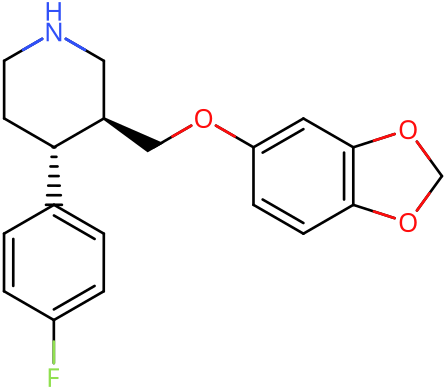
Paroxetine Stats & Data
Fc1ccc(cc1)C1CCNCC1COc1ccc2OCOc2c1AHOUBRCZNHFOSL-YOEHRIQHSA-NPharmacology
DrugBankDescription
Paroxetine is a selective serotonin reuptake inhibitor (SSRI) drug commonly known as Paxil. It has a variety of uses, including the treatment of anxiety disorders, major depression, posttraumatic stress disorder, and symptoms of menopause, among others. It was approved by the FDA in the early 1990s and marketed by SmithKline Beecham. A unique feature of this drug is that it is highly potent and selective in its inhibition of serotonin reuptake and has little effect on other neurotransmitters. Because of its potent inhibition of serotonin reuptake, paroxetine is more likely to cause withdrawal effects upon cessation. Paroxetine is well tolerated in most patients with a similar adverse effect profile to other members of its drug class. The controlled release formulation was designed to decrease the likelihood of nausea that is sometimes associated with paroxetine.
Mechanism of Action
Paroxetine enhances serotonergic activity via the inhibition presynaptic reuptake of serotonin by the serotonin (SERT) receptor. This inhibition raises the level of serotonin in the synaptic cleft, relieving various symptoms. This drug has been demonstrated to be a stronger inhibitor of serotonin reuptake than other members of the same drug class, including Citalopram, Fluoxetine, and Fluvoxamine. The mechanism of action of paroxetine in relieving the vasomotor symptoms of menopause is unknown, according to the Brisdelle prescribing information, but may occur due to its effects on thermoregulation. Paroxetine shows a clinically insignificant affinity for adrenergic alpha-1 and alpha-2 receptors and β-adrenergic receptors, dopamine D1 and D2 receptors, histamine H1 receptors and serotonin 5-HT1A, 5-HT2A and 5-HT2C receptors. This drug shows some affinity for muscarinic cholinergic receptors and 5-H2B receptors. The delayed onset of paroxetine therapeutic effects may be explained by the initial paroxetine actions on the 5-HT neurons. In rats, paroxetine activates 5-HT1A receptors when it is first administered, inhibiting the stimulation of the 5-HT neurons and subsequent release of serotonin at the synaptic cleft.
Pharmacodynamics
Paroxetine treats the symptoms of depression, various anxiety disorders, posttraumatic stress disorder, obsessive-compulsive disorder, and the vasomotor symptoms of menopause via the inhibition of serotonin reuptake. The onset of action of paroxetine is reported to be approximately 6 weeks. Due its serotonergic activity, paroxetine, like other SSRI drugs, may potentiate serotonin syndrome. This risk is especially high when monoamine oxidase (MAO) inhibitors are given within 2 weeks of paroxetine administration. Upon cessation of MAO inhibitors, a 2-week interval before paroxetine administration is recommended. Do not coadminister these agents.
Metabolism
Paroxetine metabolism occurs in the liver and is largely mediated by cytochrome CYP2D6 with contributions from CYP3A4 and possibly other cytochrome enzymes. Genetic polymorphisms of the CYP2D6 enzyme may alter the pharmacokinetics of this drug. Poor metabolizers may demonstrate increased adverse effects while rapid metabolizers may experience decreased therapeutic effects. The majority of a paroxetine dose is oxidized to a catechol metabolite that is subsequently converted to both glucuronide and sulfate metabolites via methylation and conjugation. In rat synaptosomes, the glucuronide and sulfate conjugates have been shown to thousands of times less potent than paroxetine itself. The metabolites of paroxetine are considered inactive.
Absorption
Paroxetine is readily absorbed from the gastrointestinal tract. Due to the first-pass metabolism, the bioavailability ranges from 30-60%. Cmax is attained 2 to 8 hours after an oral dose. Mean Tmax is 4.3 hours in healthy patients. The steady-state concentration of paroxetine is achieved within 7 to 14 days of oral therapy. In a pharmacokinetic study, AUC in healthy patients was 574 ng·h/mL and 1053 ng·h/mL in those with moderate renal impairment.
Indication
Paroxetine is indicated for the management of depression, obsessive-compulsive disorder, panic disorder, social anxiety disorder, generalized anxiety disorder, posttraumatic stress disorder. One form of paroxetine, commercially known as Brisdelle, is used to manage mild to moderate vasomotor symptoms of menopause. Off-label, paroxetine may be used for the treatment of premature ejaculation or irritable bowel syndrome (IBS).
Half-life
The mean elimination half-life of paroxetine is about 21 hours. In healthy young subjects, mean elimination half-life was found to be 17.3 hours.
Protein Binding
Paroxetine is 95% bound to plasma proteins.
Elimination
About 2/3 of a single paroxetine dose is found to be excreted in the urine and the remainder is found to be excreted in feces. Almost all of the dose is eliminated as metabolites; 3% is found to be excreted as unchanged paroxetine. About 64% of a 30 mg oral dose was found excreted in the urine, with 2% as the parent drug and 62% appearing as metabolites. Approximately 36% of the dose was found to be eliminated in the feces primarily as metabolites and less than 1% as the parent compound.
Volume of Distribution
Paroxetine has a large volume of distribution and is found throughout the body, including in the central nervous system. Only 1% of the drug is found in the plasma. Paroxetine is found in the breast milk at concentrations similar to the concentrations found in plasma.
Clearance
The apparent oral clearance of paroxetine is 167 L/h. The clearance of paroxetine in patients with renal failure is significantly lower and dose adjustment may be required, despite the fact that it is mainly cleared by the liver. Dose adjustments may be required in hepatic impairment.
Measured Affinities
Guide to PHARMACOLOGYMeasured binding and functional data for paroxetine, curated by the IUPHAR/BPS Guide to PHARMACOLOGY. Each row cites the paper it came from. Lower concentrations mean tighter binding — a value in the sub-nanomolar range indicates a very potent interaction.
| Target | Action | Measure | Value | Concentration | Species | Source |
|---|---|---|---|---|---|---|
| SERT SLC6A4 | Inhibition | pKd | 10.1 | 0.079 nM | Human | PMID 27049939 |
| SERT SLC6A4 | Inhibition | pKi | 9.6 | 0.251 nM | Human | PMID 9537821 |
| P2X4 P2RX4 | Antagonist | pIC50 | — | — | Human | — |
Reading this. pKi, pEC50 and pIC50 are negative log molar values, so a higher number means a tighter interaction; the concentration column converts them for you. Values from non-human species are laboratory measurements and do not translate directly to human effect. Receptor affinity is not a dose — it describes what a molecule binds, not how much of it is safe to take.
Receptor data from the IUPHAR/BPS Guide to PHARMACOLOGY (v2026.2), licensed CC BY-SA 4.0. Matched to this substance by InChIKey.
Spontaneous cases of deliberate or accidental overdosage during paroxetine treatment have been reported; some of these cases were fatal and some of the fatalities appeared to involve paroxetine alone. Commonly reported adverse reactions associated with paroxetine overdosage include somnolence, coma, nausea, tremor, tachycardia, confusion, vomiting, and dizziness. Though it is rarely lethal in overdose by itself, patients can develop somnolence, nausea, tremor, heart rhythm disturbances, confusion, vomiting, dizziness, and mydriasis. During toxicity, a patient’s airway, oxygenation, and ventilation require evaluation first.
LD50
LD50: 500mg/kg (Oral, Mouse) (A308)
Carcinogenicity
No indication of carcinogenicity to humans (not listed by IARC).
Liver injury risk
Low concern (rare serious cases reported)
Tolerance & Pharmacokinetics
drugs.wikiTolerance Decay
Experience Report Analysis
ErowidDemographics
Gender Distribution
Age Distribution
Reports Over Time
Effect Analysis
ErowidEffects aggregated from 64 experience reports (64 single-substance Erowid)
Effect Sentiment Distribution
Confidence Distribution
Each bar is the share of reports mentioning the effect; its whisker, and the band on the rows below, is the 95% interval: where the share could plausibly be with other reports of the same kind.
Positive Effects 6
Adverse Effects 7
Show 5 neutral or unclassified mentions
Also reported in combinations. In the 64 Paroxetine reports where another drug was taken too, 14 (21.9%) mention hospital, emergency services or an overdose, 2 (3.1%) a seizure and 7 (10.9%) psychosis. In the 64 single-substance reports: 9.4%, 3.1% and 4.7%. These are not in the figures above: they cannot be put down to Paroxetine alone, and a mention is not always something that happened to the writer.
Dosage Distribution
Dose distribution from experience reports, one dose per report (the first listed). Doses above Q3 + 3×IQR, far above what people typically take, are left out of the median and range and listed under each route: most are real heavy doses or overdoses, not mistakes.
1 report gave a dose above the typical range (200 mg), so it is not in the figures above. It mentions hospital, emergency services or an overdose. Listing a dose here does not mean it is safe.
Show the report
- 200 mg · another drug taken too · mentions hospital, emergency services or an overdose
Real-World Dose Distribution
ErowidFrom 141 of 148 recorded dose entries: those that state a weight (mg, g or µg), in routes with at least five of them. Values above Q3 + 3×IQR, far above what people typically take, are left out; they can include real heavy doses and overdoses, not only mistakes.
Oral (n=137)
Common Combinations
Most co-occurring substances, as a share of all 128 reports filed under Paroxetine; whiskers are 95% intervals
Form / Preparation
Most common forms and preparations, as a share of the 34 reports that give one; whiskers are 95% intervals
Body-Weight Dosing
Dose per kg of body weight, one dose per report (the first listed), from reports giving a weight of 30–250 kg. Doses above Q3 + 3×IQR, far above what people typically take, are left out of the median and range and listed under each route.
1 report gave a dose above the typical range (1.307 mg/kg), so it is not in the figures above. Listing a dose here does not mean it is safe.
Show the report
Redose Patterns
Redosing behavior across 110 reports