
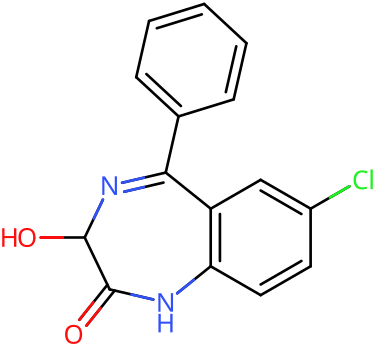
Oxazepam Stats & Data
ADIMAYPTOBDMTL-UHFFFAOYSA-NPharmacology
DrugBankDescription
Oxazepam is an intermediate-acting, 3-hydroxybenzodiazepine used in the treatment of alcohol withdrawal and anxiety disorders. Oxazepam, like related 3-hydroxybenzodiazepine lorazepam, is considered less susceptible to pharmacokinetic variability based on patient-specific factors (e.g. age, liver disease) - this feature is advantageous as compared to other benzodiazepines, and is likely owing in part to oxazepam's relatively simple metabolism. It is an active metabolite of both diazepam and temazepam and undergoes very little biotransformation following absorption, making it unlikely to participate in pharmacokinetic interactions.
Mechanism of Action
Like other benzodiazepines, oxazepam exerts its anxiolytic effects by potentiating the effect of gamma-aminobutyric acid (GABA) on GABA(A) receptors, the main inhibitory neurotransmitter receptors in the mammalian brain. GABA(A) receptors are a component of GABA-gated ionotropic chloride channels that produce inhibitory postsynaptic potentials - following activation by GABA, the channel undergoes a conformational change that allows the passage of chloride ions through the channel. The inhibitory potentials produced by GABA neurotransmission play an integral role in the suppression and control of epileptiform nerve firing such as that seen in epilepsy, which makes the GABA system a desirable target in the treatment of epilepsy. Benzodiazepines are positive allosteric modulators of GABA(A) function. They bind to the interface between alpha (α) and gamma (γ) subunits on the receptor, commonly referred to as the benzodiazepine binding site, and modulate the receptor such that its inhibitory response to GABA binding is dramatically increased.
Pharmacodynamics
Benzodiazepines, including oxazepam, exert their sedative and anxiolytic effects by potentiating the effects of endogenous GABA, the primary inhibitory neurotransmitter in the CNS. Compared to other benzodiazepines, it has relatively low potency and a moderate duration of action. Oxazepam should be administered with caution to patients for whom a drop in blood pressure may lead to cardiac complications as, in rare cases, it may cause hypotension.
Metabolism
Oxazepam has a single major inactive metabolite, a glucuronide conjugate. The glucuronidation of the S-isomer is catalyzed by UGT2B15. The glucuronidation of the R-isomer is catalyzed by UGT2B7 and UGT1A9.
Absorption
Following oral administration, peak plasma levels (Cmax) averaged 450 mg/mL and occurred approximately 3 hours (Tmax) after dosing.
Indication
Oxazepam is indicated for the management of anxiety disorders and for the short-term relief of symptoms of anxiety. It may also be used in the management of alcohol withdrawal symptoms.
Half-life
The mean elimination half-life of oxazepam is 8.2 hours.
Protein Binding
Plasma protein binding is approximately 89%, likely to albumin.
Elimination
Oxazepam is primarily eliminated in the urine as its glucuronide metabolite, with the feces containing approximately 21% of the unchanged drug. The majority of an orally ingested dose of oxazepam is excreted within 48 hours.
Receptor Profile
Receptor Actions
Receptor Binding
History & Culture
Oxazepam was patented in 1962 and received approval for medical use in 1964. The compound became one of the most commonly prescribed benzodiazepines in multiple countries during the late 20th century. In Australia during 1990-1991, oxazepam along with diazepam, nitrazepam, and temazepam accounted for approximately 82% of benzodiazepine prescriptions listed on the pharmaceutical benefits scheme. The drug has been noted as a preferred benzodiazepine among novice users in several countries, attributed to its relatively slow absorption rate and low potential for accumulation in the body. However, this widespread availability also contributed to diversion and misuse; in Sweden between 1982 and 1986, benzodiazepines including oxazepam, diazepam, nitrazepam, and flunitrazepam represented 52% of all forged drug prescriptions, indicating their status as a major drug class subject to prescription fraud. Research beginning in 2013 has examined the ecological effects of pharmaceutical contamination in aquatic environments. Laboratory studies exposing European perch to oxazepam concentrations equivalent to those present in European waterways (1.8 μg/L) documented increased activity, reduced sociality, and elevated feeding rates in exposed fish. Subsequent research in 2016 found that salmon smolt exposed to the compound for seven days prior to migration displayed intensified migratory behavior compared to controls. A 2019 study associated these behavioral changes with adverse survival outcomes, demonstrating that bolder, faster behavior in exposed smolt corresponded with increased mortality due to heightened vulnerability to predation. As a linguistic curiosity, the word "oxazepam" is reportedly the third-highest scoring word in Scrabble, valued at 392 points when played in the optimal position.
A patient with oxazepam overdose typically presents with normal vital signs with severe CNS depression. Clinical symptoms may include ataxia, slurred speech, confusion, drowsiness, and lethargy. If toxicity is suspected, maintenance of airway, breathing, and circulation must be rapid and immediate. Intubation may be necessary if there is a severe compromise. If the clinician suspects an isolated oxazepam overdose with a patient having stable hemodynamics and a relatively normal physical examination, monitoring of vital signs and clinical observation are appropriate.
Carcinogenicity
Group 2B: Possibly carcinogenic to humans
Liver injury risk
Ambiguous (limited data)
Toxicity (DrugBank)
The oral LD50 in rats and mice is >8000 mg/kg and 1540 mg/kg, respectively. Symptoms of oxazepam overdose are likely to be consistent with its adverse effect profile and range from mild to severe, sometimes fatal, CNS depression. Treatment should include gastric decontamination, via lavage or induced vomiting, followed by symptomatic and supportive measures. The benzodiazepine antagonist flumazenil may be used in hospitalized patients as an adjunct to non-pharmacological management, but may increase the risk of seizure in long-term benzodiazepine users and in cyclic antidepressant overdose.
Health effects (PubChem excerpts)
They cause slurred speech, disorientation and "drunken" behavior. They are physically and psychologically addictive.
Effect Profile
Curated + 1 ReportsStrong anxiolysis with strong cognitive impairment, moderate sedation and euphoria
Tolerance & Pharmacokinetics
drugs.wikiNo tolerance chart. Our decay curves for these drugs were estimates, and a curve can make tolerance look longer-lasting than it is, which is the dangerous direction.
How fast tolerance to these drugs fades after a break has not been measured well enough to draw, so don't count on a dose you used to take still being safe: after time off, start with a much smaller amount and don't use alone. Mixing sedatives with each other, with alcohol or with opioids sharply raises the risk of a fatal overdose. If you've been using regularly, don't stop suddenly: withdrawal from benzodiazepines, alcohol or GHB/GBL can cause seizures or delirium, so get medical help to cut down gradually.
Sources: FRANK: benzodiazepines · Alcohol and Drug Foundation: GHB · FDA 2020: benzodiazepine boxed warning · FDA 2019: gabapentinoids and breathing · NHS: alcohol use disorder
Cross-Tolerances
Experience Report Analysis
ErowidDemographics
Gender Distribution
Too few reports for a chart: gender is known from 5 reports, and a split is drawn only from 20 reports or more. Counts are shown instead. Why 20?
- Male 4 of 5
- Female 1 of 5
Age Distribution
Reports Over Time
Real-World Dose Distribution
ErowidFrom 5 of 6 recorded dose entries: those that state a weight (mg, g or µg), in routes with at least five of them. Values above Q3 + 3×IQR, far above what people typically take, are left out; they can include real heavy doses and overdoses, not only mistakes.
Oral (n=5)
Form / Preparation
Most common forms and preparations, as a share of the 3 reports that give one
Too few reports for bars: these forms come from 3 reports, and a bar is drawn only from 20 reports or more. With fewer, a percentage cannot tell a common effect from a rare one. Counts are shown instead. Why 20?
- Pill / Tablet 3 of 3
Benzodiazepine Equivalence
Oxazepam - 20mg ~=10mg Diazepam.
Legal Status
| Country | Status | Notes |
|---|---|---|
| Canada | Prescription medication | Available as a regulated prescription pharmaceutical with multiple approved brand name and generic products. Generic formulations including Apo-oxazepam have been marketed since 1979, with brand name products such as Novoxapam also historically available. As a benzodiazepine, it is classified as a controlled substance and should only be obtained through licensed pharmacies with valid prescription. |
Harm Reduction
drugs.wikiOxazepam is a 3‑hydroxy benzodiazepine and the active metabolite of diazepam and temazepam; unlike many benzodiazepines it undergoes direct glucuronidation (UGT2B15/UGT2B7/UGT1A9) to an inactive metabolite, so it has fewer CYP‑mediated interactions and is often preferred in hepatic impairment, though sedation/fall risk still applies. The mean elimination half‑life is about 8.2 hours (reported range roughly 4–21 h); onset is slow and variable with a typical Tmax around 3 hours, so avoid redosing for at least several hours to minimize cumulative CNS depression. Combining oxazepam with other depressants—particularly alcohol, opioids, GHB/GBL, or barbiturates—markedly increases risks of respiratory depression, aspiration, overdose, and death; if an opioid is taken accidentally together, seek medical help and place the person in the recovery position. Co-use with gabapentinoids and sedating antihistamines also heightens sedation and overdose risk; avoid or drastically reduce doses if such combinations cannot be avoided. Do not drive or operate machinery after dosing; psychomotor and cognitive impairment can persist into the next day, especially with higher or repeated doses. In patients with sleep apnea or significant respiratory disease, benzodiazepines can worsen hypoventilation and are generally not recommended. Paradoxical agitation, disinhibition, or irritability can occur—stop use and seek medical guidance if these appear. Abrupt discontinuation after regular use can precipitate benzodiazepine withdrawal (rebound anxiety, insomnia, tremor, and, in severe cases, seizures); taper gradually under medical supervision. Pregnancy and breastfeeding: benzodiazepines cross the placenta and appear in breastmilk; neonatal flaccidity, withdrawal, and respiratory depression are reported—avoid unless clearly indicated by a clinician. In older adults, even therapeutic doses are associated with increased risks of falls, cognitive impairment, and possible long‑term dementia associations; use the lowest effective dose for the shortest duration. Because oxazepam’s absorption is slow and its lipophilicity relatively low, non-oral ROAs provide no safety advantage and may increase harms; stick to oral use as prescribed. Consider dose equivalence cautiously when switching: a rough guide is ~20 mg oxazepam ≈ 10 mg diazepam, but individual responses vary—always reduce and re-titrate when converting.
References
Cited References
Additional references
- DrugBank: Oxazepam (PK, metabolism, half-life, Tmax)
- StatPearls (NCBI Bookshelf): Oxazepam (hepatic impairment preference, dosing, interactions, pregnancy/elderly cautions)
- TripSit Wiki: Benzodiazepines equivalence table (oxazepam 20 mg ≈ diazepam 10 mg)
- Bluelight HR compendium post: Oxazepam onset 30–120 min and half-life range
- EMCDDA/EUDA benzodiazepines drug profile (tolerance/withdrawal within weeks; class overview)
- DrugWise: Benzodiazepines (harms increased with alcohol, opioids, gabapentinoids; UK update Dec 2024)
- TripSit combinations (benzodiazepines + tramadol flagged as dangerous)
- DrugWise: Driving and specified benzos (includes oxazepam)