
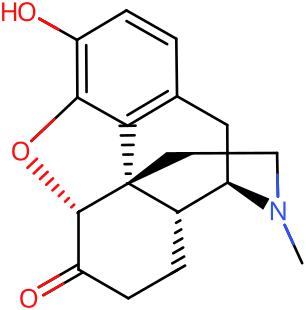
Hydromorphone Stats & Data
CN1CCC23C4CCC(=O)C3Oc3c(O)ccc(CC14)c23WVLOADHCBXTIJK-YNHQPCIGSA-NPharmacology
DrugBankDescription
Hydromorphone is a pure opioid, a semi-synthetic hydrogenated ketone derivative of morphine that has been available clinically since 1920. Structurally, hydromorphone derived from morphine in the modification of the hydroxyl group in the carbon 6 to a carbonyl and the absence of a double bond between the carbon 7 and 8. Due to these modifications, it presents a very high potency and comparable side effect profile to the parent compound. Even though hydromorphone does not present a 6-hydroxyl group, it is categorized under the family of phenanthrenes and it is considered a chemical under the schedule II (medical purposes with high addiction potential). The first reported approved product containing hydromorphone in the form of hydromorphone hydrochloride was developed by Fresenius Kabi USA and FDA approved in 1984.
Mechanism of Action
Hydromorphone is an opioid agonist that can bind to different types of opioid receptors. Its analgesic effect is suggested to be related to the effect on the mu-opioid receptors. It has been reported to also have a minor affinity for the delta and kappa receptor. On the other hand, it is known to act at the level of the medulla which allows it to depress the respiratory drive and suppress cough. The onset of action of the immediate release form of hydromorphone is achieved in 15-20 minutes and having a lasting effect for 3-4 hours while the extended-release form onset of action is of 6 hours lasting for about 13 hours.
Pharmacodynamics
In clinical trials, hydromorphone has been shown to be suitable for pain relief in patients that do not tolerate the side effects of morphine or that suffer from renal failure or asthma. It has been shown to be 5-7 times more potent than morphine with a shorter duration of analgesia. Some of the observed effects of the consumption of hydromorphone for acute pain are complete and longlasting pain relief when compared to other pain relief agents such as meperidine, morphine, diamorphine, bupivacaine, indomethacin, and fentanyl. On the same trials, hydromorphone was shown to produce respiratory depression, lower cognitive function, miosis, mydriasis, constipation, hypotension, and vertigo but to present a reduced incidence of pruritus (which indicates a lower release of histamine) and nausea. The respiratory depression is known to be caused by the effect on the brain stem respiratory centers as well as to a reduction in the responsiveness of this brain stems to increase carbon dioxide tension.
Metabolism
The metabolism of hydromorphone is mainly hepatic and it is represented by the generation of hydromorphone-3-glucuronide through glucuronidation reactions. This primary metabolic pathway is done by the activity of the UDP-glucuronosyltransferase-2B7. The first-pass hepatic metabolism is so large that it represents 62% of the initial administered dose. On the other hand, hydromorphone is also characterized by the presence of minor metabolic pathways such as the CYP3A4- and CYP2C9-driven generation of norhydromorphone.
Absorption
The immediate release version of hydromorphone reaches its peak concentration after 30-60 minutes while the extended-release version reaches the peak concentration after 9 hours. When administered orally, hydromorphone is absorbed mainly in the upper small intestine with a bioavailability of 60% due to intensive first-pass metabolism. In the controlled-release version of hydromorphone, the absorption follows a biphasic pharmacokinetic profile. However, even though there are clear distinctions in the absorption pathway of hydromorphone, the AUC of both versions is reported to be of 34 ng.h/ml which indicates an equivalence. The parenteral administration of hydromorphone, which is the most common pathway, presents an almost immediate absorption as observed by the presence of peak plasma concentration almost immediately. This peak plasma concentration declines rapidly due to fast redistribution into liver, spleen, kidney and skeletal muscle. In the parenteral route, the pharmacokinetic profile is log-linear and dose-dependent and to present a higher bioavailability of 78%. Other administration routes such as rectal, nasal, intraspinal and transdermal present lower bioavailability and changes in their pharmacokinetic profile.
Indication
Hydromorphone is indicated for the management of moderate to severe acute pain and severe chronic pain. Due to its addictive potential and overdose risk, hydromorphone is only prescribed when other first-line treatments have failed. The WHO has proposed a three-step ladder for the management of pain in which it is suggested to start with a non-opioid medication followed by addition of weak opioids to the non-opioid treatment for moderate pain and finishing in the use of strong opioids such as hydromorphone along with the existing regimen for cases of severe pain. Off-label, hydromorphone can be administered for the suppression of refractory cough.
Half-life
The half-life of hydromorphone immediate-release is of 2-3 hour while the extended release can range from 8-15 hours.
Protein Binding
The protein-bound form of hydromorphone corresponds to about 8-19% of the administered dose.
Elimination
The main elimination route of hydromorphone is through the urine in the form of the main metabolite hydromorphone-3-glucuronide. The elimination of the parent compound represents 7% of the urine elimination and 1% of the fecal elimination.
Volume of Distribution
The volume of distribution of hydromorphone is reported to be of 4 L/kg.
Clearance
The mean plasma clearance of hydromorphone is reported to be of 105.7 ml/min. The systemic clearance is reported to be of 1.96 L/min.
Receptor Profile
Receptor Actions
Receptor Binding
Measured Affinities
Guide to PHARMACOLOGYMeasured binding and functional data for hydromorphone, curated by the IUPHAR/BPS Guide to PHARMACOLOGY. Each row cites the paper it came from. Lower concentrations mean tighter binding — a value in the sub-nanomolar range indicates a very potent interaction.
| Target | Action | Measure | Value | Concentration | Species | Source |
|---|---|---|---|---|---|---|
| μ receptor OPRM1 | Agonist | pKi | 9.55 | 0.282 nM | Human | PMID 19282177 |
| κ receptor OPRK1 | Agonist | pKi | 8.55 | 2.82 nM | Human | PMID 19282177 |
| δ receptor OPRD1 | Agonist | pKi | 7.42 | 38.02 nM | Human | PMID 19282177 |
Reading this. pKi, pEC50 and pIC50 are negative log molar values, so a higher number means a tighter interaction; the concentration column converts them for you. Values from non-human species are laboratory measurements and do not translate directly to human effect. Receptor affinity is not a dose — it describes what a molecule binds, not how much of it is safe to take.
Receptor data from the IUPHAR/BPS Guide to PHARMACOLOGY (v2026.2), licensed CC BY-SA 4.0. Matched to this substance by InChIKey.
History & Culture
1920–1926
Hydromorphone is a semi-synthetic opioid derived from morphine through hydrogenation, producing a more potent hydrogenated ketone derivative. The compound has been available for clinical use since approximately 1920 and was patented in 1923. The German pharmaceutical company Knoll introduced hydromorphone to the mass market in 1926 under the brand name Dilaudid. This trade name was chosen to indicate the compound's derivation from and similarity to morphine, referencing laudanum (a historical tincture of opium). The Dilaudid brand became so widely recognized that it is frequently used generically to refer to any formulation containing hydromorphone, regardless of manufacturer.
2005–present
An extended-release formulation of hydromorphone marketed as Palladone was introduced to the United States market but was voluntarily withdrawn following a July 2005 advisory from the U.S. Food and Drug Administration. The warning highlighted a significant overdose risk when the medication was consumed with alcohol, which could compromise the extended-release mechanism and result in rapid release of the full dose. Despite its withdrawal from the American market, extended-release hydromorphone has remained available in other regions. As of 2010, it was marketed in Nepal under the brand name Opidol, in the United Kingdom as Palladone SR, and throughout most other European countries under various trade names.
2009–present
In 2009, the state of Ohio approved the use of hydromorphone as a component of its lethal injection protocol. The method involves an intramuscular injection of 500 milligrams of hydromorphone combined with a supratherapeutic dose of the benzodiazepine midazolam. This protocol serves as a backup procedure for capital punishment cases in which a suitable vein cannot be located for conventional intravenous injection.
2022–present
Hydromorphone remains widely prescribed in clinical settings for the management of moderate to severe pain. In 2022, it ranked as the 233rd most commonly prescribed medication in the United States, with more than one million prescriptions dispensed that year.
Like most opioids, unadulterated hydromorphone does not cause many long-term complications other than psychological and physical dependence and constipation. The harmful or toxic aspects of hydromorphone's usage as a recreational substance are exclusively associated with not taking appropriate precautions in regards to its administration, overdosing, and using impure or adulterated batches of the substance. Heavy dosages of hydromorphone can result in respiratory depression, leading onto fatal or dangerous levels of oxygen deprivation. This occurs because the breathing reflex is suppressed by agonism of µ-opioid receptors - this effect is proportional to the dosage of opiates consumed.
Carcinogenicity
No indication of carcinogenicity to humans (not listed by IARC).
Toxicity (DrugBank)
The reported LD50 of hydromorphone in the mouse was of 104 mg/kg when given intravenously and 84 mg/kg when given orally. The reports of overdose with hydromorphone are characterized by respiratory depression, somnolence, skeletal muscle flaccidity, cold and clammy skin, constricted pupils, myosis, mydriasis, bradycardia, hypotension, apnea, circulatory collapse, cardiac arrest, and even death. The management of an overdose might require assisted ventilation, supportive measures, as well as cardiac massage and defibrillation. It can be recommended the use of naloxone solely in the cases of respiratory depression. The use of opioid antagonist should be restricted to patients that present respiratory depression as they can produce acute abstinence symptoms. Hydromorphone was not shown to be mutagenic nor clastogenic and long-term studies of carcinogenicity studies have not been performed. On the other hand, reduced implantation sites and viable fetuses were noted at a 2X normal concentration.
Effect Profile
Curated + 67 ReportsStrong euphoria, pain relief, and sedation with strong itching/nausea
Tolerance & Pharmacokinetics
drugs.wikiNo tolerance chart. Our decay curves for opioids were estimates, and a curve can make tolerance look longer-lasting than it is, which is the dangerous direction.
Opioid tolerance drops fast when you stop, and even a few days off can be enough, so a dose that used to be normal can now stop your breathing. Overdose deaths rise sharply after prison, detox or leaving treatment, and tolerance also falls during a hospital stay. After any break, start with a much smaller amount, try a test dose first, don't use alone, and keep naloxone within reach. Alcohol, benzodiazepines, gabapentinoids and other sedatives make an opioid overdose much more likely.
Sources: FRANK: heroin · National Harm Reduction Coalition · WHO: opioid overdose · Merrall et al. 2010 · Binswanger et al. 2007 · Strang et al. 2003 · FDA 2019: gabapentinoids and breathing
Cross-Tolerances
Demographics
Gender Distribution
Age Distribution
Reports Over Time
Effect Analysis
Erowid + BluelightEffects aggregated from 67 experience reports (46 single-substance Erowid + 21 Bluelight)
Effect Sentiment Distribution
Confidence Distribution
Each bar is the share of reports mentioning the effect; its whisker, and the band on the rows below, is the 95% interval: where the share could plausibly be with other reports of the same kind.
Positive Effects 27
Adverse Effects 25
Show 5 more adverse effects
Show 14 neutral or unclassified mentions
Also reported in combinations. In the 24 Hydromorphone reports where another drug was taken too, 10 (41.7%) mention hospital, emergency services or an overdose, 1 (4.2%) a seizure and 1 (4.2%) psychosis. In the 46 single-substance reports: 39.1%, 0.0% and 2.2%. These are not in the figures above: they cannot be put down to Hydromorphone alone, and a mention is not always something that happened to the writer.
Dosage Distribution
Dose distribution from experience reports, one dose per report (the first listed). Doses above Q3 + 3×IQR, far above what people typically take, are left out of the median and range and listed under each route: most are real heavy doses or overdoses, not mistakes.
Real-World Dose Distribution
ErowidFrom 72 of 86 recorded dose entries: those that state a weight (mg, g or µg), in routes with at least five of them. Values above Q3 + 3×IQR, far above what people typically take, are left out; they can include real heavy doses and overdoses, not only mistakes.
Intravenous (n=24)
Insufflated (n=23)
Oral (n=18)
Common Combinations
Most co-occurring substances, as a share of all 70 reports filed under Hydromorphone; whiskers are 95% intervals
Form / Preparation
Most common forms and preparations, as a share of the 42 reports that give one; whiskers are 95% intervals
Body-Weight Dosing
Dose per kg of body weight, one dose per report (the first listed), from reports giving a weight of 30–250 kg. Doses above Q3 + 3×IQR, far above what people typically take, are left out of the median and range and listed under each route.
Insufflated
Intravenous
Oral
1 report gave a dose above the typical range (0.153 mg/kg), so it is not in the figures above. Listing a dose here does not mean it is safe.
Show the report
- 0.153 mg/kg · another drug taken too
Redose Patterns
Redosing behavior across 49 reports
Opioid Equivalence (MME)
NIH HEAL 2024 & CDC 2022Hydromorphone 2 mg oral ≈ 10 mg Morphine oral
Legal Status
| Country | Status | Notes |
|---|---|---|
| Australia | Schedule 8 | Controlled drug under the Poisons Standard. Illegal to possess without a valid prescription or license. Schedule 8 substances are those with high abuse potential requiring restricted supply. |
| Austria | Prescription only (SMG/AMG) | Legal for medical use under the Arzneimittelgesetz (AMG). Possession or sale without a valid prescription is illegal under the Suchtmittelgesetz (SMG - Narcotics Act). |
| Canada | Schedule I (CDSA) | Controlled under Schedule I of the Controlled Drugs and Substances Act. Note that Canadian schedules differ significantly from US scheduling classifications. |
| Germany | Anlage III BtMG | Controlled substance under Anlage III of the Betäubungsmittelgesetz (Narcotics Act). Can only be prescribed using a narcotic prescription form (Betäubungsmittelrezept). |
| Russia | Schedule II | Classified as a Schedule II controlled substance under Russian narcotics legislation. Unauthorized possession and distribution are prohibited. |
| Sweden | Prescription only | Regulated as a prescription-only medication. Available for medical use but requires valid prescription from authorized healthcare provider. |
| Switzerland | Verzeichnis A | Controlled substance specifically listed under Verzeichnis A of Swiss narcotics legislation. Medicinal use is permitted with appropriate authorization. |
| Turkey | Red prescription | Requires a 'red prescription' (kırmızı reçete) for dispensing, indicating strict controlled substance status. Illegal to sell or possess without valid prescription. |
| United Kingdom | Class A, Schedule 2 | Controlled under the Misuse of Drugs Act 1971. Class A designation carries the most severe penalties for unauthorized possession or supply. Schedule 2 permits medical prescribing under strict controls. |
| United States | Schedule II | Controlled substance under the Controlled Substances Act. Illegal to sell without a DEA license and illegal to buy or possess without a valid license or prescription. Classified as having high addiction potential but accepted medical use. |
Harm Reduction
drugs.wikiHydromorphone is ~5–7× as potent as morphine; small dosing errors—especially by IV or in non‑tolerant users—can cause fatal respiratory depression. Co‑use with other CNS depressants (benzodiazepines, alcohol, GHB/GBL, Z‑drugs) markedly increases overdose risk due to additive/synergistic respiratory depression; avoid these combinations and keep naloxone on hand. Intranasal bioavailability clusters around ~50–60%, while oral figures vary widely (~30–60% across sources), so insufflated doses should usually be lower than oral for comparable effect. Extended‑release (ER/CR) tablets contain tamper‑resistant polymers; crushing/heating/injecting them can cause gelled clots, pulmonary emboli, and dose dumping—do not inject ER/CR products. If people inject diverted tablets despite risks, use sterile water, new equipment every time, and a 0.22 µm micron filter to remove insoluble binders; never share or reuse syringes to reduce BBV risks (HIV/HCV). In unregulated markets, counterfeit ‘Dilaudid’/opioid tablets may contain fentanyl, nitazenes, benzos, or xylazine; consider drug checking and treat unknown pills as very potent—start with a tiny ‘allergy’ dose and use fentanyl test strips when available. Renal impairment increases risk of accumulation of hydromorphone metabolites (e.g., H3G) that are associated with neuroexcitatory effects; reduce exposure and seek medical advice if kidney function is reduced. Compared with morphine, hydromorphone tends to cause less histamine‑mediated pruritus, but constipation, nausea, and drowsiness are common; hydrate and consider a bowel regimen if used repeatedly. After a period of abstinence (e.g., detox, jail, illness), tolerance drops quickly and ‘usual’ doses can become lethal—restart at a fraction of prior dose. Carry naloxone and train peers: give 1–4 mg IN or 0.4–2 mg IM/IV, repeat every 2–3 minutes if no response, provide rescue breathing and place in recovery position while waiting for EMS; multiple doses may be needed with potent adulterants. Avoid driving or hazardous tasks for at least several hours after dosing; residual impairment may outlast euphoria. Rotating between opioids requires caution due to incomplete cross‑tolerance; when changing substances or routes, reduce expected equivalent doses and titrate slowly.
References
Data Sources
Cited References
- Coda et al. 2003 - Pharmacokinetics and Bioavailability of Intranasal Hydromorphone
- Darke and Zador 1996 - Fatal Heroin Overdose: A Review
- Davis et al. 2004 - Bioavailability of Intranasal Hydromorphone in Rhinitis Patients
- Erowid: Hydromorphone Vault
- Gregory 2013 - Hydromorphone: Evolving to Meet Healthcare Challenges
- Siegel et al. 1982 - Heroin Overdose Death: Contribution of Environmental Cues
- TripSit: Hydromorphone Factsheet
- DrugBank: Hydromorphone Salt
- DrugBank: Clinical Trials - Hydromorphone
Additional references
- DrugBank: Hydromorphone (mechanism, potency, PK, adverse effects)
- TripSit Drug Combinations guide (opioids × depressants = dangerous)
- TripSit: Opioids overview (comparisons)
- Bluelight Dilaudid/Hydromorphone MEGA thread (BA, injection risk discourse)
- Bluelight Bioavailability/Half‑life thread (hydromorphone BA figures)
- Erowid Opioid Vault – Hydromorphone (routes, duration overview)
- Hi‑Ground: Opioids page (route‑specific HR; unsafe combos)
- Bluelight: Managing opioid overdose (naloxone dosing & response)
- DrugWise: Gabapentin – risks with CNS depressants including opioids
- Drug checking service reports (prevalence of benzos/xylazine with illicit opioids)